Natural stone suppliers should be compared through the actual material, available selection and intended application behind each offer. A commercial name and attractive sample can leave the proposed batch, finish, fabrication scope and applicable performance evidence unresolved. Buyers need those inputs connected before deciding which proposal is ready for the next project commitment.
Begin with a common enquiry basis, then retain each supplier’s actual response and its limits. Separate material identity, appearance selection and project suitability while linking them to the same offered stone. This makes quotations and alternatives easier to assess without converting a brochure, sample or generic report into proof of the complete supply.
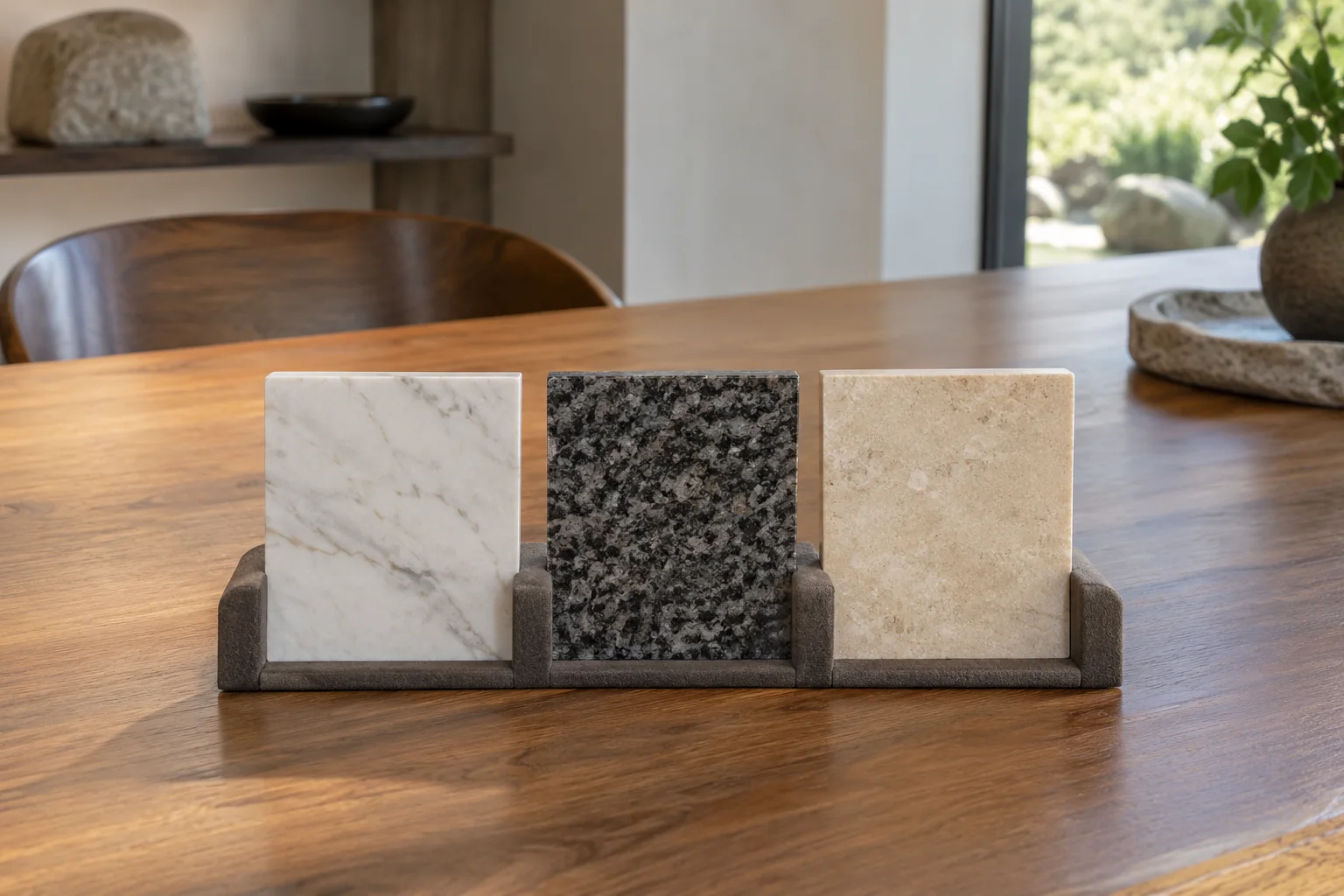
AI-generated material-selection references, without verified mineral identity, offered stock or an actual supplier batch.
What should natural stone suppliers quote against?
Define the common project enquiry
For natural-stone sourcing, identify the intended application, relevant project locations and required supply form. Distinguish slabs, finished pieces and other proposed products where appropriate. A broad material enquiry can produce plausible offers that cover different work, leaving the buyer unable to compare them on a common acceptance basis.
Give each supplier the current drawings or relevant dimensional references, appearance intent and destination information available at enquiry. Identify which inputs remain provisional. The quotation should state the proposal’s assumptions so that an early budget or option review does not silently become approval to fabricate against unfinished project information.
Ask the supplier to identify the actual proposed material, finish and available configuration, together with relevant source or batch references available at that stage. Keep unavailable information marked as an open item. The buyer needs to distinguish an identified offer from an attractive material name whose actual supply has not yet been established.
Compare the scope behind the price
Record which selection, fabrication, inspection, packing and delivery items each quotation includes. Ask which responsibilities belong to another party. A figure for raw slabs should not be compared as though it describes a finished installed package when the required cutting, interfaces or handover work remains outside that proposal’s stated scope.
Clarify the applicable commercial terms directly, including any quantity, price or timing condition that affects the purchase. Retain the actual response rather than assuming a standard minimum order or lead time for a material family. An unresolved term should remain connected to the relevant proposal so that its uncertainty is visible during comparison.
For whole-house material coordination, connect each stone item with the current package and room references. Keep the supplier’s own scope identifiable within the broader order. A coordinated purchase can organize related materials while leaving the buyer responsible for comparing the actual conditions and acceptance limits behind each offered item.
How should natural stone suppliers identify materials and batches?
Distinguish names from identified material
A commercial stone designation can serve a different purpose from a scientific material identification. Ask natural stone suppliers which identity each offer uses and what relevant evidence supports it. The buyer should retain the offered name and available technical designation together, without treating a familiar marketing description as a complete statement of behavior in the intended application.
For marble slab options, identify the proposed source, actual available selection and relevant finish references. A small specimen can support an appearance discussion while leaving the broader slab range unresolved. Ask what the offered material and retained sample represent before extending that approval to the proposed order.
For granite slab options, connect the material designation with the actual intended pieces and applicable technical evidence. Keep source or selection differences visible when comparing alternatives. A shared commercial group does not by itself establish that two offers preserve the same appearance, fabrication or project acceptance basis.
Link the retained selection to the offer
The material register gives each proposal an inspectable reference rather than relying on a repeated catalogue image.
| Comparison input | Record to request | Responsible reviewer | Acceptance question |
|---|---|---|---|
| Material identity | Offered name and relevant technical designation | Supplier and project specialist | What material is actually proposed |
| Selection identity | Available slab/batch references and scope | Supplier and buyer | What the appearance record represents |
| Finish and treatment | Actual product information and retained specimen | Supplier and material reviewer | Which surface condition is accepted |
| Application | Location, exposure and current project requirements | Designer and technical reviewer | Which use the proposal must meet |
| Technical evidence | Applicable report and sample/context linkage | Qualified material reviewer | What the record can establish |
| Supply scope | Included fabrication, packing and handover items | Supplier and buyer | Which responsibilities remain elsewhere |
Ask how the actual offered selection will be identified through approval and any later changes. Retain the relevant slab, lot or other available references with the accepted appearance record. This is a request for a traceable supply basis, without assuming that every supplier uses a particular production process or batch-coding system.
If the available material changes, identify what changed and which accepted reference it affects. The buyer needs a response before treating new slabs or another source as interchangeable with the original offer. A retained commercial name does not establish that the earlier appearance or technical comparison automatically covers the revised selection.

Which application and report evidence is useful?
State the relevant use conditions
Give the qualified reviewer the actual application, proposed material and relevant project requirements together. A countertop, floor and exterior panel can raise different acceptance questions. The buyer should identify the intended use rather than asking a general durability statement to cover every location in the material schedule.
For quartzite slab consideration, retain the actual material identity and proposed application before comparing performance descriptions. Ask which applicable evidence addresses the requirement that matters to the project. A stone name or mineral-like appearance cannot establish suitability for an unknown countertop, floor or other use.
For onyx slab consideration, identify whether the proposal includes a relevant lighting, backing or other assembly decision. Ask the responsible parties to define the actual arrangement and evidence it needs. A striking specimen should not inherit acceptance for a complete application whose associated components and conditions remain unspecified.
Review reports within their actual scope
Where testing is relevant, ask the qualified reviewer to identify the applicable methods and evidence needed for the proposed material and use. Obtain the actual report with its material and specimen information, relevant condition and scope. This article does not prescribe universal stone values, mandatory tests or a current standard version for an unidentified destination.
Ask how the report relates to the material now offered and which assumptions limit its use. A record for another source, specimen or condition can require a further applicability response. Keep that question attached to the proposal instead of treating the existence of a report as complete acceptance of every slab or fabricated piece.
Distinguish material evidence from assembly acceptance. A relevant property report does not by itself establish the project’s support, fixing, cutting or installation arrangement. Have the responsible specialists review those relationships where applicable. The procurement file should make the scope of each response visible so that one accepted record does not replace several different decisions.
How should natural stone suppliers document appearance and fabrication?
Agree the range and layout reference
Ask which actual appearance references will control the proposed order and what each one represents. Retain the selected material, finish, comparison conditions and accepted range where relevant. An unusually uniform specimen or cropped detail photograph can leave the buyer without a usable basis for judging the broader selection or the appearance of adjacent pieces.
Where slab arrangement affects the result, connect the actual selected slabs with the proposed layout and piece references. Ask the designer and fabricator which orientation, joins and visible areas need agreement. A concept rendering can establish design intent while leaving the actual material allocation and fabrication arrangement open to a later controlled review.
For floor medallion coordination, identify the pattern, selected materials and applicable piece or template references separately from general slab approval. The buyer needs to know which design and fabrication decisions belong to that item. An accepted material sample should not silently authorize a different pattern, layout or installation interface.
Preserve actual interface responsibilities
For kitchen cabinet and countertop coordination, retain the relevant support, opening and appliance or fixture inputs with the stone piece references. Ask the responsible parties which arrangement they accept. A slab quotation should not be treated as a complete countertop-interface response when those project relationships remain undecided.
For bathroom basin and stone coordination, use the actual basin and mounting references when reviewing the proposed countertop piece. Identify who owns the cutout, support and related service questions. A preferred stone finish cannot establish that an assumed opening or fixture arrangement is accepted for fabrication.
If the layout, piece geometry or adjoining item changes, identify its effect on the accepted material allocation and interface references. Retain the revised comparison before the affected work is released. A change described as minor should still have a traceable response when it alters which physical material or fabrication decision the original approval covered.

What should delivery and care scope include?
Connect packing with identifiable supply
Ask how the accepted material and fabricated pieces will be identified in the proposed packing and receiving records. Agree which references the receiving team needs before dispatch. An attractive packing photograph cannot establish that every carton or crate contains the particular selection, orientation or piece configuration that the buyer accepted.
Give the supplier the relevant site receiving and distribution information available for the proposed order. Have the qualified logistics and site parties define the applicable arrangements. Procurement should retain their responsibilities and accepted scope without prescribing a generic lifting, unloading or storage method for heavy material whose actual dimensions and conditions remain unknown.
Clarify which packing, delivery and handover items the quotation includes and what the buyer or other contractor must arrange. Confirm the actual commercial and destination requirements with the responsible parties. This guide does not supply universal customs descriptions, tariff rates, shipping durations or packaging certification for an unidentified shipment.
Retain material-specific operating information
For outdoor-surface alternatives, define which proposed product and exposure each enquiry covers when comparing it with a natural-stone option. Keep the applicable evidence separate. A similar color or texture does not establish that unrelated materials share the same installation, performance or maintenance basis for the project.
Request the care and relevant treatment information applicable to the actual stone and finish. Ask the makers and operator to assess the proposed routine against that selection and its adjoining materials. A general stone-care statement should not become a universal cleaner, sealing interval or promise that every appearance change can be prevented.
Confirm which accepted references and component or treatment information will remain available at handover. Identify any support or commercial term that requires a direct supplier response. The buyer needs usable records for the supplied material without inventing an availability guarantee, fixed response time or service-life outcome based on a supplier profile.

What should natural stone suppliers resolve before release?
Compare evidence against the next commitment
Before release, ask natural stone suppliers to confirm the accepted material, selection, application and relevant project references. Ask which technical, appearance and supply questions are complete and which remain provisional. The decision should state whether it authorizes selection, fabrication, dispatch or another named commitment, rather than using approved as an unqualified status for the whole proposal.
For engineered-quartz alternatives, define the actual alternative product and its own application evidence if it enters the comparison. Retain the new material and interface response. A visual resemblance to the preferred stone should not extend the natural-stone selection’s approval to a different product configuration without an applicable review.
The disposition table keeps a supplier response connected to the requirement it resolves.
| Observed condition | Evidence to obtain | Buyer response | Scope to revisit |
|---|---|---|---|
| Material name is ambiguous | Offered identity and relevant technical record | Request clarification | Material selection basis |
| Available slabs change | Identified current selection and appearance review | Review before replacement | Affected material allocation |
| Report scope is unclear | Specimen/source/context applicability response | Hold affected technical acceptance | Named application requirement |
| Fabrication interface changes | Current piece and counterpart review | Revise before release | Related cutting and support work |
| Packing linkage is missing | Accepted item and receiving references | Obtain delivery response | Identified shipment items |
| Commercial or care scope is open | Applicable supplier and operator records | Retain explicit condition | Relevant purchase or handover commitment |
Preserve observations and revised decisions
At receiving, compare identified supply and visible condition with the agreed scope. Record which items were inspected and what needs a response. Intact protection does not prove material suitability, and a visible difference does not establish its cause. Keep the observation, supplier or technical response and final disposition identifiable within the relevant proposal.
When a new source, finish, selection or application is proposed, retain the previous basis and the revised comparison together. Identify which relationship changed and why the next commitment may proceed. A new commercial name or replacement photograph without that response can disconnect the material now offered from the decision the buyer originally accepted.
Use a limited disposition when its scope is limited. The buyer should be able to identify the affected pieces or requirement while keeping other accepted work traceable. Approval of one sample or report should not cover unexamined selections, and a concern with one identified item should retain its actual boundary in the receiving and order record.

Conclusion
Compare suppliers through identified material, available selection and applicable project evidence. Keep the appearance references, technical report scope, fabrication interfaces and supply responsibilities connected to the same offer. A common enquiry basis helps the buyer see which proposal is ready for the next commitment and which missing inputs still prevent release.
Before ordering, retain the actual commercial response and the applicable receiving and care scope. Revisit the affected decision when the source, slabs, finish, geometry or intended use changes. A supplier profile, retained sample or generic report remains useful within its stated purpose, while the current material and project configuration need a clear acceptance basis of their own.
Use Sibolla’s material coordination services to discuss the stone schedule, retained references and open application or fabrication questions. Confirm the proposed supply and review responsibilities directly before authorizing the order.
Frequently Asked Questions
What makes two natural-stone quotations comparable?
Use a common intended application, supply form and current project basis, then identify each actual material, finish, selection and included work. Retain supplier assumptions, commercial conditions and unresolved acceptance questions so that different scopes are not compared as one complete package.
Can a commercial stone name establish its suitability?
No. Retain the offered name, relevant material identity and evidence applicable to the actual intended use. Ask the qualified reviewer to assess that proposal. A familiar name or attractive appearance cannot establish every technical and project interface requirement.
Does one test report approve every offered slab?
Review the actual report’s material, specimen, source, condition and scope with the responsible specialist. Determine how it relates to the present offer and which application it supports. The existence of a report does not by itself establish acceptance of an unexamined selection or complete assembly.
When should a stone-source substitution be reviewed again?
Revisit the affected acceptance when the source, selection, finish, technical evidence, fabrication geometry or intended application changes. Retain the current comparison and explicit disposition before extending the earlier appearance, technical or order release to the new proposal.