
Building materials sourcing quotations should be compared only after the buyer has reconciled their quantities, product configurations, exclusions and delivery basis. Two totals can describe different packages. A useful comparison shows the difference clearly enough for procurement to request a correction, accept a documented alternative or keep a line provisional.
For a contractor purchasing several interior categories overseas, the key task is to create one comparison baseline. An inexpensive cabinet line may omit fittings. A door price may cover a leaf while another includes the frame and selected hardware. A ceiling offer may price visible panels without the components needed for the specified arrangement. Those differences require clarification before supplier ranking.
This article focuses on quotation normalization. It does not set market prices, prescribe contract terms or promise savings. Use the method to turn different supplier offers into a record your procurement and project teams can review together.
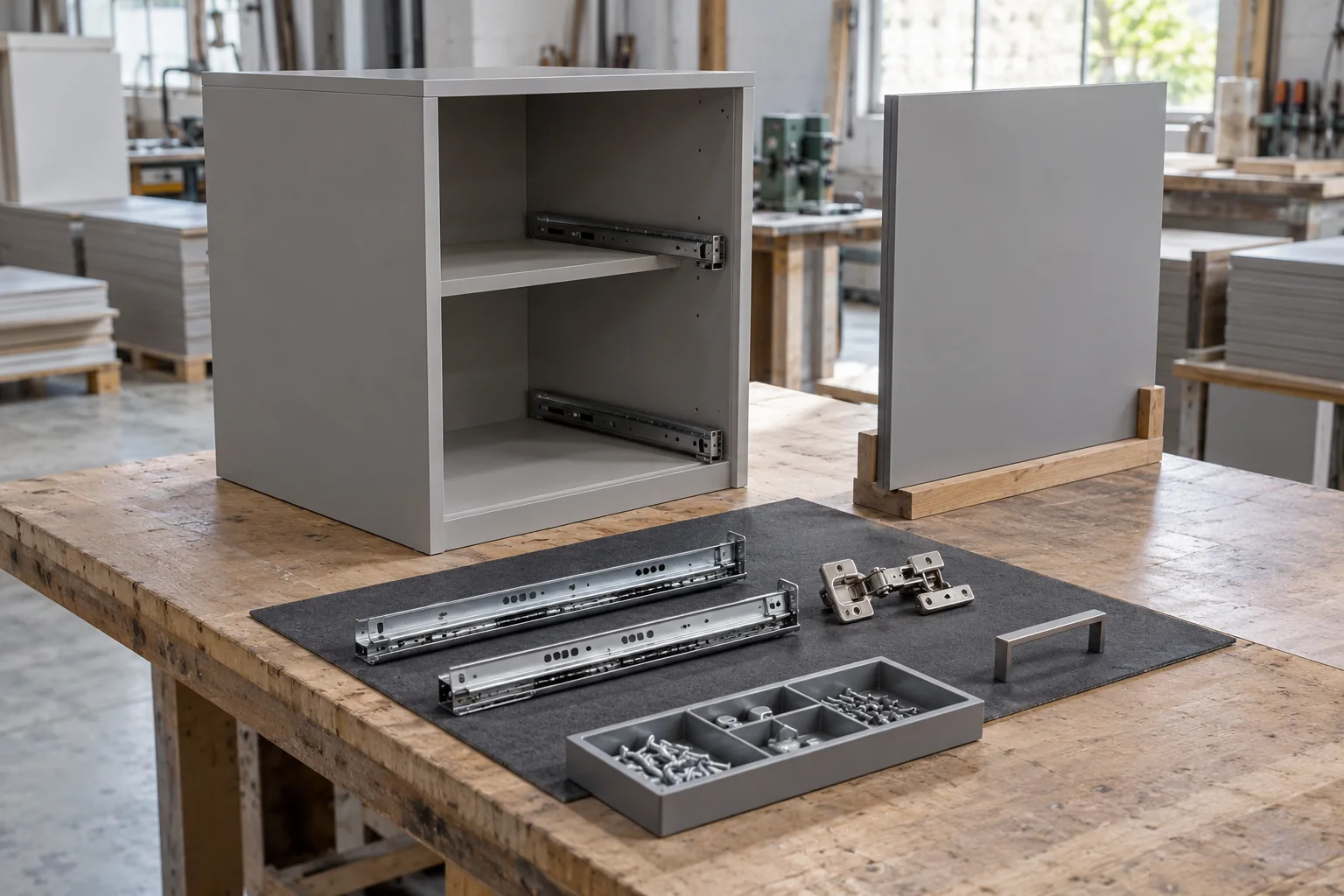
AI-generated illustration of quotation scope; objects shown do not identify a real offer or supplier price.
What defines the building materials sourcing comparison?
Issue one description for each priced line
Give each BOQ line an identifier, location, quantity, unit and configuration reference. Attach the drawing and specification revisions needed to describe it. A supplier should be able to connect its price with the buyer’s requested item without guessing whether a later image or message changed the scope.
Use the custom cabinet category to separate complete cabinet assemblies from individual panels, fittings or accessories. The wording of a priced line should explain what the quantity counts. A cabinet count, an area measure and a linear measure cannot be compared by treating them as interchangeable units.
Define the commercial boundaries of the baseline
State whether the requested offer covers product supply, drawing development, samples, inspection, packing and other agreed services. Describe the intended destination and handover point at the level available. Ask suppliers to list assumptions where information remains incomplete.
The following fields establish a comparable pricing request before the buyer reviews totals.
| Comparison field | Input issued to suppliers | Evidence in the offer | Question if missing |
|---|---|---|---|
| Item identity | BOQ line and room reference | Matching item description | Which requested line is priced? |
| Quantity basis | Defined count or measurement unit | Quantity, unit and calculation basis | What has been included in the measure? |
| Configuration | Drawing and material revision | Product and component scope | Which parts differ from the request? |
| Services | Included tasks and review stages | Included and excluded work | Who prices the remaining tasks? |
| Delivery basis | Destination and agreed handover scope | Packing and transport responsibilities | Which costs require separate confirmation? |
| Offer conditions | Requested currency and approval basis | Validity, assumptions and qualifications | What change could revise this price? |
This table establishes the inquiry basis. Keep it separate from the later decision table, which evaluates differences found in actual responses. A blank response should become a clarification request rather than an assumption that the missing task is included.
How do units affect building materials sourcing quotes?
Check the meaning behind the number
Ask suppliers to show the basis of measured or counted quantities. A stone area may refer to finished pieces, purchased slab area or an allowance before layout. A ceiling area may describe a zone while its supporting and edge components follow other measures. The buyer needs to know which scope the number represents.
For stone supply, connect the quotation with the proposed material form and fabrication scope. Clarify whether the offer includes cutting, edge work, openings, selected layout and packaging for finished components. An area total alone does not answer those questions.
For tile procurement, distinguish the intended installed area from the quantity being ordered. Layout, cutting, batch planning and the buyer’s replacement strategy can influence the order basis. Ask the project team to approve the appropriate allowance rather than importing an unsupported percentage from another project.
Resolve scope changes before arithmetic
When a supplier proposes a different format or module, review the quantity consequence with the relevant drawing. A different product arrangement can change the number of components, visible joints, trims or installation tasks. Comparing unit prices before that review can create a misleading result.
Reconcile omissions and double counts across categories. A countertop support, fixing component or finish panel may appear in two offers or in neither. Give the disputed component one owner in the comparison record and ask both suppliers to confirm their treatment.
Keep an audit trail for changed quantities. Record the original basis, reason for revision and accepted basis used for ranking. Procurement should be able to explain why a supplier’s total changed without relying on a spreadsheet cell whose underlying scope has disappeared. Return the reconciled quantity schedule to the suppliers when necessary so the final price follows the same request.

Which component differences require technical review?
Compare complete configurations
Describe a product beyond its category name. For a cabinet, compare the specified components, materials, finishes and fittings. For a door, compare the leaf, frame, glazing where relevant, seals, selected hardware and the preparation required for installation. A similar catalog appearance cannot establish an equivalent configuration.
The doors and windows range provides the category context, while the project schedule defines the assembly to price. Ask suppliers to identify variations line by line. The responsible reviewer should decide whether each variation remains suitable for the stated use.
For bathroom fittings, check the model, mounting arrangement, connection requirements, included parts and finish reference. A substituted product can affect another trade’s work. Keep those effects visible beside the price difference instead of assuming the installer will resolve them later.
Avoid unsupported equivalence claims
Ask what evidence supports an alternative. Relevant documents may include current technical sheets, material identities, samples or a project-specific review. A supplier’s statement that two options have similar quality does not identify the dimensions, functions or conditions being compared.
For lighting fixture sourcing, coordinate the proposed complete model with the project’s power, control, mounting and maintenance requirements. An alternative driver or control arrangement can require a different review. Product appearance alone does not establish electrical or system compatibility.
Mark alternatives as proposed until the authorized reviewer accepts them. If an offer contains both the requested configuration and a cheaper option, keep them as separate comparison lines. Procurement can then understand the price effect without quietly changing the technical baseline.
Where evidence cannot be obtained, keep the affected comparison unresolved. A lower total becomes useful only when the buyer knows what it purchases and which conditions remain outside the offer.
How do exclusions and allowances affect building materials sourcing costs?
Make omitted tasks visible
Ask suppliers to identify the work excluded from each line and the package as a whole. Relevant examples can include installation materials, site installation, local service connections, destination handling, storage or specialist testing required by the contract. The actual exclusions depend on the offered scope.
Review staircase supply alongside the responsibilities for site measurements, engineering information, erection and fixing. A fabrication price does not automatically include every site task associated with a staircase. Obtain the relevant project’s scope statement rather than transferring a different supplier’s advertised service package.
Assign excluded work to the party who will estimate it. If that estimate is unavailable, retain an unresolved comparison amount or note. Recording an omission as zero makes an incomplete offer appear more certain than it is.
Keep provisional items separate from firm lines
An allowance can support planning while the final selection remains open. Identify what the allowance assumes and what later information will revise it. A provisional finish, uncertain quantity or unselected fitting should remain identifiable through the offer revision process.
For soft furnishing packages, the quoted basis may depend on actual dimensions, material selection and installation arrangement. Ask how the supplier will convert the planning allowance into a defined order. A preliminary room price should not become a production commitment through repeated copying.
Distinguish an offered service from a measurable deliverable. If design support is included, define the drawings, review stages or other outputs relevant to this package. If inspection is included, identify its scope and the evidence supplied. The comparison should make those tasks understandable without assigning them an invented market value.
Return the exclusions register with the normalized offer for confirmation. Keep commercial qualifications attached to the price they modify so they cannot be lost when totals are summarized for management.
What delivery conditions change the complete comparison?
Separate product cost from arrival responsibilities
For building materials sourcing, record the named delivery basis and requested handover conditions in each offer. Ask which party arranges export packing, transport booking, documentation, destination handling and receiving. Review the actual agreement with the relevant logistics and project teams; this article does not prescribe a trade term.
For furniture orders, check whether the proposed packing and assembly condition match the handling route and site’s delivery access. A compact shipping arrangement may require additional site assembly. Compare that responsibility openly rather than treating product prices as complete installed costs.
Request the packing basis for fragile or finished materials. State whether a quotation assumes consolidated shipment, separate category consignments or a later logistics estimate. The buyer needs the assumptions even when transport prices cannot yet be confirmed.
Relate arrival plans to approvals
Review the sequence that supports the proposed delivery date. Identify document approval, sample decisions, material commitments, production, inspection and packing dependencies. Separate that sequence from transport and site receiving conditions. A production duration alone does not describe a complete arrival plan.
When considering whole-house supply coordination, ask whether all categories must wait for one shipment or whether agreed phases remain possible. The appropriate choice depends on installation priorities, storage and which components need to arrive together.
Record the commercial effect of a changed phase. Extra packing, handling or repeated documentation may require a revised offer. A split shipment can be useful while still carrying costs or responsibilities that the initial total did not describe.
Do not add an unverified freight estimate and present the result as a confirmed landed cost. Show confirmed lines, conditional lines and unresolved destination amounts separately. Procurement can rank an adequately defined product package while keeping the necessary logistics comparison open for a later decision.

Which building materials sourcing commitments need written terms?
Record what triggers each commitment
Read the proposed payment schedule and ask what each stage authorizes. Identify how deposit, material reservation, production release, inspection and shipment relate in the supplier’s offer. The buyer’s own procurement and contract reviewers should evaluate the actual terms and associated protections.
Request a written explanation of how scope changes are handled. A change made before material procurement can have a different effect from one requested after fabrication. Ask the supplier to identify committed work and the approval required for a revised price or schedule. Do not assume an alternative is available at the original unit price.
Preserve conditions when presenting the comparison
Use one stated currency for the management comparison and retain original offer currencies and dates in the supporting record. If conversion is required, record the agreed rate source and date rather than inserting an unverified current rate. Keep conversion assumptions separate from supplier prices.
Record offer validity and any supplier qualification affecting reordering or material availability. A price may depend on the stated order size, configuration or procurement date. Ask what must be reconfirmed if the buyer changes the order later. Avoid writing a future price or repeated supply commitment into the comparison without evidence.
The project supply system can support a discussion about responsibilities across categories. Your comparison still needs the specific proposed milestones and change conditions attached to the relevant offer.
Before circulating the result, ask whether a manager could understand the remaining decisions from the summary. Include unresolved exclusions and proposed alternatives beside the totals. A clean-looking ranking can hide uncertainty if the buyer removes qualifications merely to make the sheet shorter.
When are the quotations ready for a supplier decision?
Decide what each difference means
Review the offers against the agreed baseline and classify meaningful differences. Some require a corrected price. Some need technical approval. Others remain valid commercial choices that procurement can compare directly. Connect each observation with the party able to resolve it.
Use the following decisions before treating a quotation as comparable.
| Difference observed | Comparison effect | Buyer action | Evidence before ranking |
|---|---|---|---|
| Different quantity units | Unit prices describe unlike measures | Reconcile the quantity basis | Confirmed BOQ and calculation basis |
| Missing assembly components | Scope may be incomplete | Request a completed configuration | Revised itemized offer |
| Alternative specification proposed | Technical baseline has changed | Obtain scoped technical review | Identified accepted or rejected alternative |
| Site task excluded | Complete project cost is unresolved | Assign and estimate the task | Written exclusion and responsible estimate |
| Delivery assumptions differ | Arrival costs and timing may differ | Normalize handover and phase basis | Agreed logistics responsibilities |
| Remaining scope agrees | Offers can support a decision | Compare defined commercial differences | Final confirmed offer revisions |
The table converts response differences into actions. It does not assign universal weighting to suppliers or claim that one commercial arrangement fits every project.
Close the comparison with an agreed record
Ask the selected supplier to confirm the final baseline, accepted alternatives, exclusions and applicable conditions. Attach the agreed drawing and specification references to the commercial record. Keep rejected or superseded offers distinguishable from the version accepted for the order.
Retain the reason for selection in terms procurement can defend. That might involve a clearer included scope, an accepted configuration or an arrival arrangement suited to the site. Describe the actual evidence without turning a decision preference into an unsupported claim about the supplier’s general quality.
Before issuing the next commitment, check that outstanding technical approvals are identified and that the commercial decision does not release unresolved production inputs by implication. A quotation comparison closes a buying question; manufacture may still require its own documented approval.

Conclusion
Compare building materials sourcing offers through the package they actually describe. Reconcile item identity, units and configurations first, then make exclusions, allowances and delivery responsibilities visible. Keep proposed alternatives separate until the relevant reviewer accepts their technical and interface consequences.
Use the comparison to assign practical next actions. Ask for a revised line where a component is missing, a clarified basis where quantities differ, and a separate estimate where another party must complete excluded work. Leave uncertain costs and schedules conditional instead of turning them into confirmed totals.
When preparing an enquiry, send the same BOQ, drawing revisions, material descriptions and intended handover conditions to the suppliers being compared. Request an itemized response and a visible qualifications schedule. You can use building materials sourcing support to discuss the package inputs and scope questions, then keep the agreed comparison record attached to the final offer before making the next purchasing commitment.
Frequently Asked Questions
Can we compare quotations before every material is selected?
Yes, if provisional selections and allowances are identified consistently. Compare the defined portion of the package and retain the assumptions affecting the rest. Ask each supplier how the offer will change when the remaining materials, quantities or components receive final approval.
Should a missing item be treated as included at no extra cost?
Request confirmation. Silence does not establish inclusion. Ask the supplier to describe the item, its price treatment and any resulting change to the package total. If another party must supply it, assign that responsibility and keep the unresolved estimate visible.
How do we evaluate a cheaper alternative material?
Identify the proposed specification and ask the responsible project reviewer to examine suitability, interfaces and required evidence. Keep the original and alternative prices separate until approval. Include any change to drawings, samples, installation or delivery responsibilities in the comparison.
Does an export price establish the full cost at the site?
It depends on the written scope and handover basis. Confirm packing, transport, documentation, destination handling and site receiving responsibilities. Keep uncertain amounts conditional. Do not present an assumed logistics estimate as a confirmed arrival cost.
What should we keep after selecting a quotation?
Retain the accepted offer revision, baseline BOQ, drawings, specifications, approved alternatives, exclusions and commercial conditions. Record why material differences were accepted or resolved. Keep outstanding production approvals visible so quotation acceptance cannot accidentally authorize unresolved fabrication.