Supplier audits help identify gaps before overseas material and furniture orders become binding. I recommend checking ten areas against the actual product, factory and destination. An audit should produce evidence and corrective actions; it cannot guarantee compliance or on-time delivery by itself. See Sibolla Building for related project options.
Key Takeaways
- Learn about global supply chain risks to make better choices and stop expensive delays.
- Do regular audits to find problems early and follow rules.
- Make sure materials are real by checking them at the factory and testing them in a lab.
- Look at supplier certifications to see if they follow world and local rules.
- Use strong packaging to keep materials safe when shipping and stop damage.
- Keep clear records and track materials to follow the rules.
- Watch how suppliers do by using important numbers to check quality and delivery time.
- Care about sustainability by picking eco-friendly materials and good waste management.
Supplier Audits and Global Supply Chain Risk
Key Risk Factors
Getting building materials and furniture from other countries is hard. These risks can change your project’s cost, timing, and quality. If you know about these risks, you can make smarter choices and stop problems early.
Here is a table with common risk factors for building materials and furniture OEM factories:
| Risk Factor | Description |
|---|---|
| Fluctuating raw materials prices | Prices can go up or down fast. This changes what you pay. |
| Supply chain woes | Delays in parts or materials can stop making things. |
| Regulatory compliance | Tough rules can mean fines if you break them. This can keep your products out of markets. |
| Forecasting errors | Bad guesses can mean too much or too little inventory. This hurts sales and slows projects. |
| Cyber risks | Hackers can attack systems. You need strong cybersecurity to keep your supply chain safe. |
You should look out for these risks too:
- Supplier insolvency can take away a main supply without warning.
- Strikes at ports can stop cargo from moving.
- Tariffs and trade sanctions can change costs very fast.
- Pandemics can make it hard to find workers.
- Extreme weather can break roads and factories.
- Cyberattacks on other systems can stop work.
For a coordinated material package, ask us to define supplier checks, inspection responsibilities and reporting. Keep unresolved risks visible before approving purchases.
Impact on Project Outcomes
Global Supply Chain Risk can change how well your project goes. If you do not handle these risks, you might get delays, spend more money, or even lose your project.
Here is a table that shows how these risks can affect your project:
| Impact Factor | Description |
|---|---|
| Material Delivery Delays | Late materials can push back your project and cost more. |
| Increased Material Prices | Price changes can make you spend too much, especially with fixed contracts. |
| Global Supply Chain Risks | Problems in the supply chain can bring new issues you did not expect. |
| Cost Overruns | Even small price jumps can take away your profit. |
| Program Delays | Shipping delays can hurt your schedule like labor shortages. |
| Need for Risk Management Strategies | You need strong risk management to handle these problems and keep your project going. |
Material cost exposure varies by project. Use the actual bill of materials, quotation validity and contingency budget to assess the effect of price or delivery changes.
Audits can identify process and documentation gaps. Agree corrective actions and verify their closure; an audit report does not eliminate supplier or logistics risk.
Tip: Always ask for inspection reports and keep clear records. This helps you find problems before they get big.
Supplier Audits: Furniture Material Verification
Verify the specified materials against approved samples, purchasing records and relevant test reports. Agree what the supplier must demonstrate before shipment.
Authenticity Checks
You should always check if your raw materials are real and good. Here are some easy ways to do this:
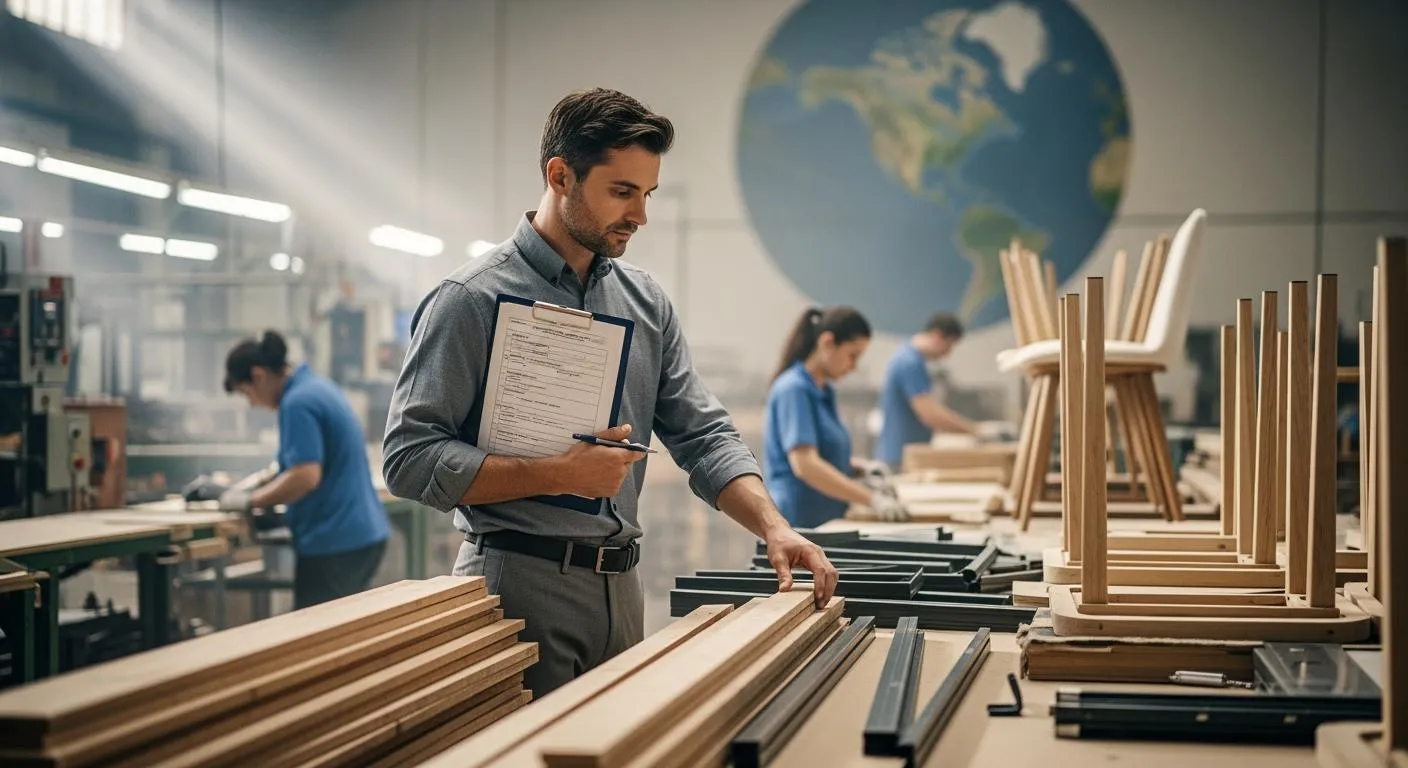
- On-site audits and inspections help you find problems early. You can visit the warehouse, look at materials before making things, and check finished products before they ship.
- Laboratory testing lets you see how materials work. You can test for strength, how much they can take, and if they have bad chemicals.
- Sustainability and traceability are important. You should keep good records and use data to track where your materials come from. This helps you follow rules and avoid fake products.
Request evidence for critical materials and verify the source, scope and product identity. A sample alone cannot establish legal compliance or batch consistency.
Tip: Always ask for proof of where materials come from and test results from your supplier. This keeps your project safe and on track.
Supplier Certifications
Certification and documentation requirements depend on destination, product and sourcing route. Confirm the applicable requirements before ordering.
- Timber legality: Check the origin, supply chain and documents required for the destination. Do not treat one country’s certificate as universal clearance.
- Market-specific approvals: Check whether the exact furniture category requires a mandatory standard, licence or marking in the destination.
Verify certificate validity, scope and supplied product identity. Ask the responsible importer or compliance adviser to confirm unresolved market requirements.
On-Site Testing
You can use on-site tests to check your furniture’s quality. These tests show if the product is strong, safe, and ready to use. Here is a table with common tests and what they do:
| Test area | Requirement to agree |
|---|---|
| Durability | Relevant product method, loading and acceptance criteria |
| Stability | Tested configuration and applicable product requirement |
| Upholstery smoulder resistance | Applicable US requirements under 16 CFR 1640 / TB 117-2013 |
| Finish and fabric | Defined test method, exposure and acceptable result |
Agree routine inspections and any laboratory tests in advance. Request reports identifying the inspected batch or tested configuration.
Note: Regular testing and clear records keep your project safe from hidden risks.
Supplier Audits: Structural Integrity Checks

Image Source: pexels
You need to check if each piece of furniture is strong and safe. This step helps you stop problems before they happen. If you do not check, things can break or hurt people. Clients will not be happy if things go wrong. Sibolla Building has a simple way to make sure everything is good.
Finished Product Inspection
You should look at finished furniture before it leaves the factory. This check tells you if the furniture can hold weight and stay strong. The table below explains what structural integrity means and why it is important:
| Aspect | Description |
|---|---|
| Definition | Structural integrity means furniture can hold weight and not bend or break. |
| Factors Influencing Integrity | Materials, shape, and how parts connect all matter. |
| Importance | Good integrity means your furniture lasts and stays safe. |
Inspect joints, frames, fixings and welds against the drawings. Functional checks can reveal visible issues, but informal pushing does not replace specified load or stability testing.
Tip: Use a checklist when you inspect. This helps you find small problems before they get worse.
Load and Stress Testing
You need to know how much weight your furniture can take. Load and stress tests show if the furniture will last in real life. These tests also show how different things can change how long it lasts. The table below shows what you should test:
| Structural test area | What to specify |
|---|---|
| Static loading | Product type, load positions and acceptance criteria |
| Repeated loading | Method, cycles and tested configuration |
| Impact | Applicable product method and loading conditions |
| Stability | Use conditions, installation and anti-tip arrangements |
You should also think about how different stresses work together. For example, heat can make things weaker. Chemicals can make surfaces break down. The table below explains these effects:
| Interaction Type | Impact |
|---|---|
| Mechanical-Chemical | Good surfaces help the product stay strong. |
| Mechanical-Thermal | Heat can make things lose strength or crack. |
| Thermal-Chemical | High heat can make chemical damage happen faster. |
Check the tested product, report scope and results against your specification. A report for another model is not proof for the supplied furniture.
Manufacturing Process Review
You should check how the factory makes each product. This helps you find weak spots in how things are made. You want to see that the factory uses good materials and clear steps. They should check quality at every stage.
Here are some things to do in a process review: Watch how workers put together frames and joints. Check if machines cut and shape parts the right way. Make sure the factory uses the right glue, screws, or welds. Look for a team that checks quality for each batch.
Ask us to identify relevant process and inspection checkpoints for the proposed order. Record deviations and corrective actions before accepting the batch.
Callout: A strong process means fewer problems and happier clients.
Supplier Audits: Compliance with Standards
You have to follow strict rules when you buy building materials and furniture from other countries. These rules keep your project safe and legal. If you do not follow them, you might get delays or fines. Your goods could even get stopped at the border. Knowing these standards helps you avoid big mistakes and lower Global Supply Chain Risk.
International and Local Regulations
Every country has its own rules for building materials and furniture. You need to check both international and local standards before you buy anything. These rules cover things like fire safety, strength, and chemicals. Many projects also need proof that your products meet these rules.
Here is a table that shows the main types of rules you should know:
| Requirement type | How to verify |
|---|---|
| Destination rules | Identify the product-specific safety, emissions and building requirements |
| Project specification | Agree any additional performance tests and acceptance criteria |
| Markings and declarations | Confirm which requirements apply to the exact product |
| Management certificates | Review system scope; they do not certify every product |
CE marking applies only to products covered by the relevant EU rules. It is not a universal furniture certificate. ASTM references are standards or methods; ISO management certificates have a different scope. See [1].
Tip: Make a checklist of all the rules your project needs. This helps you remember every important rule.
Documentation Review
You need the right papers to show your products follow the rules. Customs officers and inspectors will ask for these papers. If you do not have them, your shipment can get stopped or delayed.
Here are some important papers and checks you should collect:
- Paint and coating requirements: Check applicable lead limits and supporting evidence for the product and destination.
- Composite wood: Check applicable formaldehyde requirements, such as EPA TSCA Title VI for covered US products. [2]
- Restricted chemicals: Verify applicable product and jurisdiction-specific limits rather than assuming one nationwide rule.
- Warnings and labels: Confirm any applicable destination obligations using the specified materials and exposure assessment.
- US upholstered furniture: Confirm applicable 16 CFR 1640 / TB 117-2013 smoulder-resistance requirements. [3]
- Mechanical hazards: Identify requirements for the actual category, such as children’s products or storage furniture where applicable.
- Technical descriptions: Show important details about furniture products.
- Project tests: Record any additional performance criteria required by the contract.
You should keep all certificates, test reports, and technical sheets together. Check these papers before you ship anything. This step helps you find problems early and keeps your project moving.
Note: Good records protect you from Global Supply Chain Risk and show your clients you care about safety and quality.
Supplier Audits: Safety and Risk Controls
Product Safety Features
You need to make sure every piece is safe. Safety features keep people from getting hurt. Check for these features before you accept anything.
- Rounded edges and corners: Sharp edges can hurt people. Rounded edges make furniture safer for kids and older adults.
- Stable bases and anti-tip devices: Tables and shelves should not tip over. Anti-tip kits and wide bases help stop accidents.
- Documented finishes: Check applicable chemical restrictions and emissions evidence for the specified product.
- Fire performance: Specify relevant requirements where applicable; a flammability result does not mean furniture is fireproof.
- Secure hardware: Screws and hinges must stay tight. Loose hardware can make parts break or fall.
Match reports and declarations to the applicable product and requirement. Keep open compliance questions separate from passed checks.
Here is a table of common product safety features and why they matter:
| Safety Feature | Why It Matters |
|---|---|
| Rounded corners | Stops cuts and bruises |
| Anti-tip devices | Keeps furniture from falling over |
| Non-toxic finishes | Protects health |
| Fire resistance | Lowers fire risk |
| Secure hardware | Stops breakage and injury |
Agree the safety checks and supporting records required before shipment. Ask us to identify any checks outside the inspection scope.
Worker Safety Protocols
You should care about how factories keep workers safe. Safe workers make better products. You lower your risk when you pick factories with strong safety rules.
Key worker safety protocols include:
- Task-specific PPE: Check protection for dust, noise and chemicals. Review gloves around moving machinery against the task risk assessment.
- Machine safety guards: Machines should have guards to stop injuries. Check that workers know how to use these guards.
- Clear walkways and exits: Factories must keep floors clean and exits open. This helps workers escape fast in an emergency.
- First aid and emergency plans: Factories should have first aid kits and clear plans for fires or accidents. Workers must know what to do if something goes wrong.
- Regular safety training: Workers need training on how to use tools and machines safely. Training should happen often, not just once.
Note: You can ask for records of safety training and accident reports. This shows the factory cares about its workers.
Review factory safety procedures, training records and observable conditions. Ask us which supplier information can be shared for your due diligence.
By checking both product safety and worker safety, you protect your project and your reputation. You also help make the world safer for everyone.
Supplier Audits: Sustainability and Environmental Practices

Image Source: unsplash
Define environmental requirements in measurable terms. Request relevant material and factory evidence rather than assuming every green claim is verified.
Sustainable Materials
Check timber sourcing, recycled-content claims and emissions data separately. Water-based adhesives or natural materials do not automatically establish low emissions or lower environmental impact.
- Pick wood that has a clear source.
- Choose products made with recycled stuff.
- Ask for low-VOC finishes to keep the air safe.
Tip: Picking sustainable materials helps the planet and keeps your project safer for everyone.
Waste Management
Factories make lots of waste when making things. Good waste management keeps the factory clean and helps the earth. Check if your supplier sorts and recycles their waste. Some factories use leftover wood to make new things. Others recycle metal and plastic scraps. Ask if the factory has a plan for handling chemicals and paints safely.
Here are some ways factories handle waste:
- Sort wood, metal, and plastic for recycling.
- Reuse scraps to make new products.
- Treat water and chemicals before they leave the factory.
You can ask your supplier for photos or reports about their waste management. This helps you see if they use good methods.
Note: Good waste management saves money and keeps workers safe in the factory.
Environmental Certifications
Environmental management and product labels address different matters. Check current validity, issuer and certificate scope before relying on them.
Here is a table of common certifications you might see:
| Certification | Description |
|---|---|
| FSC | Focuses on sustainable forestry practices and aims to stop unwanted wood sources. |
| level™ | Checks sustainability based on environmental and social rules in the supply chain. |
| GREENGUARD | Makes sure products meet tough indoor air quality rules and are low emitting. |
| ISO 14001 | An international rule for environmental management systems, showing care for the earth. |
A factory management certificate does not prove every supplied product meets environmental or health requirements. Match each document to the claimed benefit.
Callout: Picking certified products helps you follow project rules and shows you care about the planet.
Supplier Audits: Documentation and Traceability
Keep records linking approved specifications, purchased materials, batch inspections and shipped items. Traceability supports verification but does not establish compliance by itself.
Audit Trail
An audit trail is a record of every step in your supply chain. You use it to track choices, check rules, and build trust with partners. You should keep records for your team, customers, and the public. Each group needs different details.
Here is a table that shows how you can organize your audit trail:
| Level | Audience | Purpose | Examples |
|---|---|---|---|
| Internal | Compliance, operations teams | Risk management, decision-making | Full supplier database, audit findings, remediation tracking |
| B2B | Customers, auditors, supply partners | Due diligence, partnership building | Certification copies, compliance declarations, audit summaries |
| Public | Consumers, investors, civil society | Brand trust, accountability | Supplier lists, sustainability reports, progress updates |
A shared batch register and controlled document versions may be sufficient. Consider digital passports or specialist systems only where they fit the product and applicable requirements.
Tip: Keep your audit trail current. This helps you answer questions quickly and avoid delays.
Product Traceability
Product traceability means you can follow your materials from start to finish. You need this to meet rules and keep your supply chain strong. If you lose track of materials, you can have problems with rules or quality.
You can improve traceability by:
- Tracking raw materials from start to finish.
- Recording where each material comes from and how it moves.
- Using clear records to show you use legal and safe sources.
- Capturing data on every step to check for sustainable sourcing.
- Reducing waste by knowing exactly what you use.
Ask your suppliers for proof of where materials come from and how they move. This helps you show your clients and auditors that you follow all rules.
Traceability helps investigate defects and demonstrate relevant sourcing claims. Identify the actual records required for the destination.
Shipping Documentation
Separate routine transport documents from product-compliance and timber-sourcing records. The documents required vary with product, origin and destination.
Here is a table of key documents you should collect:
| Document category | What to check |
|---|---|
| Commercial invoice and packing list | Description, quantities, values, weights and package references |
| Transport document | Shipment details and consignee information |
| Origin documents | Required claim or destination documentation where applicable |
| Product evidence | Relevant reports, declarations, labels and certificates |
| Timber due diligence | Additional origin or geolocation records only where applicable |
Keep these papers together and check them before shipping. This step helps you avoid customs delays and keeps your project moving.
Callout: Good records and traceability help you feel safe and protect your reputation.
Supplier Audits: Process Controls and Consistency
You need strong process controls to keep things the same. Clear steps and regular checks help you get good products every time. Sibolla Building uses these controls to stop mistakes and keep quality high.
SOPs and In-Process Checks
Standard operating procedures (SOPs) show workers what to do. SOPs help everyone follow the same steps for each job. This means you get the same results and fewer errors. Visual work instructions make it easy for all workers to understand.
You should check your work during production, not just at the end. These checks help you find problems early. You can use inspection plans to decide what to check and when. If something is wrong, you fix it right away.
Here is a table that shows the best process controls for keeping things the same:
| Evidence Type | Description |
|---|---|
| Standardized Processes | Work instructions help you make fewer mistakes and keep things the same. |
| Automation | Automated orders help you avoid errors and work faster. |
| Quality Control | You set clear rules to make sure products are good. |
| Inspection Protocols | Careful checks at every step help you keep quality high. |
| Testing | You test samples to see if they meet your rules. |
| Monitoring | Watching quality numbers helps you keep things the same. |
Evaluate whether work instructions reduce recurring defects using the factory’s own records. Verify training, revision control and corrective actions rather than assuming a fixed improvement percentage.
Tip: Use checklists and pictures to make SOPs simple. This helps you find mistakes before your clients do.
Continuous Improvement
You should always look for ways to do better. Continuous improvement helps you find new ways to work and keeps your products strong. Lean Manufacturing and Lean Six Sigma help you cut waste and work faster. These methods help you make fewer mistakes and keep things moving.
Here are some ways factories get better:
- Lean Manufacturing uses 5S to keep the workspace neat and safe.
- Lean Six Sigma helps you work faster and make fewer mistakes.
- Kanban systems help you keep track of parts and keep work moving.
- SMED and TPM help you fix slow spots and stop delays.
You can follow these steps to make your factory better:
- Clean and organize your workspace with 5S.
- Make clear steps for every job.
- Use flow and pull systems to manage work.
- Fix slow spots with quick changes and good care.
Note: Continuous improvement helps your factory handle new problems. Your team learns and gets better with every project.
Check whether the stated process controls are used on the proposed product line. Ask us to agree inspection points and acceptance criteria for the order.
Supplier Audits: Packaging and Shipping Readiness
Packaging Quality
You need strong packaging to keep things safe during shipping. Good packaging stops damage, water, and rough handling. You should check every shipment before it leaves the factory.
Inspectors look at important things when they check packaging. They want to see if the packaging fits your project and follows safety rules. Here is a table that shows what you should check:
| Criteria | Description |
|---|---|
| Packaging Materials | Inspectors look at things like carton grade, inside packaging, and how boxes are sealed. |
| Carton Construction | They check the size, wall strength, and if the box is sealed well for safe shipping. |
| Cushioning and Protection | They look for enough padding, parts kept apart, and safe spots for breakable items. |
| Labeling and Markings | They check product info, barcodes, and if labels follow the rules. |
You should always check if the packaging is strong and meets the rules. Make sure the boxes are built well and will not break. Check for enough padding inside. Look at the labels to see if they are right.
If you use good packaging, you stop things from breaking or getting lost. Thick boxes and foam help protect corners and edges. Clear labels help workers know how to handle the boxes. Good packaging also makes it easy to count and check things when they arrive.
Tip: Ask your supplier for pictures of the packaging before it ships. This helps you find problems early.
Shipping Compliance
You must follow shipping rules to send things to other countries. Every country has its own rules for building materials and furniture. You need to check these rules before you ship.
First, make sure you have all the right papers. These are invoices, packing lists, and certificates. Customs officers will ask for these papers. If you forget one, your shipment can be delayed or sent back.
Next, check if your packaging follows world rules. Some countries want special marks or symbols on boxes. Others want proof that wood packaging was heat-treated or cleaned. Ask your supplier to show proof for each rule.
You also need to follow rules for dangerous goods. Some things, like glue or paint, need special care. You must label these things clearly and use safe boxes.
Here are some steps you can follow for shipping compliance:
- Get all shipping papers before loading.
- Check that packaging has the right marks and labels.
- Confirm whether wood packaging falls within applicable ISPM 15 requirements and verify required treatment marks.
- Use safe boxes for any dangerous goods.
- Check customs rules for each country on your route.
Correct documentation and packaging can reduce avoidable delays. Keep contingency time because inspections, congestion and other disruptions can still occur.
Note: Good shipping compliance keeps your supply chain smooth and your project on time.
Supplier Audits: Qualification and Monitoring
Qualify the factories supplying critical materials. Compare current capacity, product capability and corrective-action records rather than relying on a general trusted-supplier claim.
Supplier Audits
You should check your suppliers before you start working with them. Keep checking them as your project goes on. Audits help you find problems before they stop your project. They also show if your supplier can follow the rules and give you what you need.
Here are some reasons to do supplier audits:
- Audits can identify supplier weaknesses before they disrupt the project.
- They help you find risks and check if rules are followed.
- Audits look for weak spots in how things are made.
- They help you see what your supplier can really do.
- Audits show if your supplier can handle your orders and spot hidden costs.
You can hire outside inspectors to do these audits. They give you an honest report and help you find problems early. Regular audits keep your supply chain strong and your project safe.
Set audit frequency according to supplier risk and project activity. Review after significant process, ownership, product or compliance changes.
Performance Metrics
You need to check how well your suppliers do their job. Use clear numbers to track cost, delivery, quality, risk, new ideas, and how fast they answer. This helps you see if your supplier is good and where you need to improve.
Here is a table of key performance metrics:
| Metric Group | Key Metrics | Description |
|---|---|---|
| Cost | Pricing consistency | Tracks expenses and price changes. |
| Delivery | On-Time Delivery Rate | Measures if orders arrive when you need them. |
| Lead Time | Shows how long it takes from order to delivery. | |
| Quality | Defect Rate | Counts how many items fail quality checks. |
| Return Rate | Shows how many items you send back due to problems. | |
| Risk | Compliance Score | Checks if your supplier follows all rules and standards. |
| Financial Risk Rating | Looks at your supplier’s financial health. | |
| Innovation | Improvement Initiatives | Counts how often your supplier suggests better ways to work. |
| Responsiveness | Responsiveness | Measures how fast your supplier solves problems. |
You should look at these numbers every month or every few months. This helps you see problems early and fix them before they get worse.
Ongoing Development
You should help your suppliers get better over time. Work with them to set goals and share feedback. Good suppliers want to improve and follow new rules.
Key things for picking suppliers include:
- Quality and following all needed certifications.
- Being stable with money so they do not close suddenly.
- Having enough workers and skill for your project.
- Fair prices, not just the cheapest.
- Good communication and service.
You can teach your suppliers new skills or share good ideas. Ask them to suggest new ways to work. This keeps your supply chain strong and ready for new projects.
Note: Helping suppliers get better builds trust and helps you face new problems together.
Use the ten checks to record evidence, gaps and corrective actions. Resolve critical findings before approving production or shipment.
Send me your material list, destination and required reports. We can review which supplier checks belong in the procurement scope.
Supplier Audits FAQ
Collect commercial and transport documents plus the product-specific evidence required for the destination. Confirm the list before shipment; documents alone do not guarantee clearance.
Choose an interval based on supplier risk, project stage and previous findings. Review significant changes and confirm corrective actions are closed.
Product traceability lets you follow materials from start to end. You can find problems quickly. You can also prove your materials are legal and safe.
Ask for samples and test results from your supplier. You can visit the factory to look at materials yourself. This helps you avoid fake or bad materials.
Review working conditions, task-specific safety procedures and training records. Verify any ISO 45001 certificate’s scope; certification does not replace observation.
Ask us to define the available supplier-check and inspection scope. Use independent technical or compliance support where the requirement needs it.
References and Sources
- European Commission — CE marking and applicable product rules ↩
- U.S. Environmental Protection Agency — Formaldehyde standards for covered composite wood products ↩
- U.S. Consumer Product Safety Commission — Upholstered Furniture: 16 CFR 1640 and TB 117-2013 ↩
Sources checked on 27 September 2026. Standards and guidance apply within their stated scope; project recommendations are Kyle’s procurement judgment.