
Tariff surges can change the landed cost of imported doors and windows. I start with the actual product classification, country of origin and entry date. A sourcing plan can manage exposure, but cannot promise exemption from US duties. See Sibolla Building for related project options. [1]
Key Takeaways
- Check applicable duties and trade remedies before comparing door and window quotations. See doors and windows for related project options.
- Use different suppliers to lower risks from tariff changes and keep a steady supply.
- Use free trade agreements to save money and finish projects faster.
- Track shipments in real time to watch them and stop delays.
- Check all costs before buying to know what you will spend.
- Keep up with policy changes so you can change your sourcing plans fast.
- Get help from compliance experts to follow U.S. import rules and standards.
- Make strong partnerships with suppliers for better talks and trust.
U.S. Tariff Surges and Supply Chain Impact
Image Source: unsplash
Recent Tariff Changes
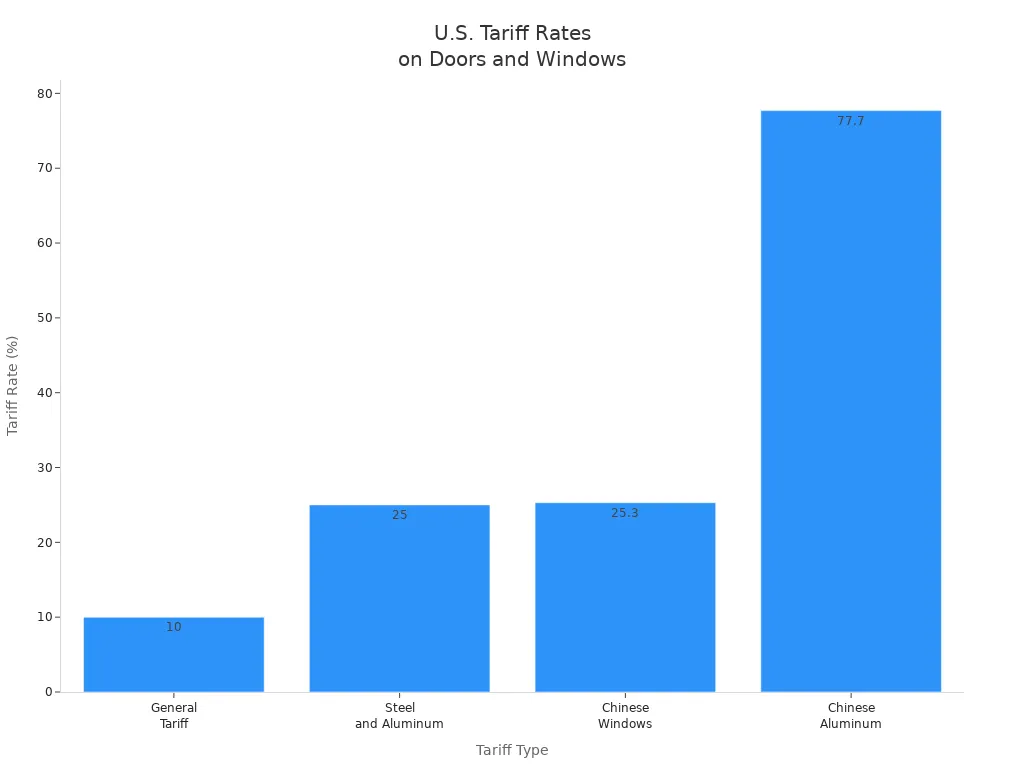
Different materials and product classifications can attract different US duties and trade remedies. Historical headline rates are not a current quotation for a particular door or window. Use the current HTSUS and broker-confirmed entry treatment. [2]
| Cost component | Required check |
|---|---|
| Ordinary customs duty | Current HTSUS classification and rate |
| Additional duties | Applicable origin- and product-specific measures |
| Trade remedies | Antidumping or countervailing order scope and exporter treatment |
| Other entry costs | Fees, broker charges and inland logistics |
Cost and Compliance Challenges
U.S. Tariff Surges make it tough to plan and budget. Builders must pick materials fast because tariffs can change quickly. You might pay more for doors and windows, especially from China. This makes building cost more and rebuilding after disasters harder. The Window & Door Manufacturers Association says you need help with tariffs on imported parts. They want lawmakers to remove tariffs on important materials. This helps keep homes affordable and projects on time.
Use current government notices and industry explanations to identify issues, then confirm the legal treatment for the actual goods.
You need to support local manufacturing and also buy from other countries. Tariffs can slow down projects and make homes cost more. You must follow new rules and keep up with changing laws.
Shifting Sourcing Models
Qualified alternative suppliers can reduce concentration risk. Any change in origin must reflect real production and applicable rules. Bonded storage may defer duty under specific conditions; Incoterms allocate responsibilities and do not remove tariff liability.
| Strategy | Constraint |
|---|---|
| Qualified alternatives | Compare real production origin, specifications and delivery capability |
| Lawful product design | Classify the actual imported article; obtain expert advice for changes |
| Bonded arrangements | Confirm eligibility, procedures and eventual duty obligations |
| Incoterms | Agree freight, insurance and customs responsibilities separately |
| Document control | Keep dated classification, origin and entry evidence |
You can use these ideas to lower risks and keep your supply chain strong. U.S. Tariff Surges make you change fast and find better ways to get materials.
Sourcing Doors and Windows During Tariff Surges

Image Source: pexels
Nearshoring and Regional Options
You can spend less money by buying doors and windows from nearby countries. Many builders now pick suppliers close to the United States. Poland is a good choice for this. You get good prices and strong quality from Poland. Shipping from Poland is easier than from China. Polish suppliers can match or beat China’s prices when you count shipping and risk. You also get better delivery and support. European supply chains, like Poland’s, help you finish projects on time and keep costs low.
Compare qualified suppliers against the approved specification. Ask which sourcing locations and support services are actually available; do not assume a supplier operates factories in several countries.
Supplier Diversification
You can keep your projects safe by using more than one supplier. If you only use one country, you face big risks when tariffs or problems happen. Some builders who only used China saw prices go up and deliveries slow down. When they added U.S. suppliers, they lowered risks and kept working.
If adding suppliers, qualify their materials, drawings and capacity before ordering. Compare the resulting landed cost and coordination workload rather than assuming diversification always lowers duties.
Here are steps to find good suppliers for doors and windows:
| Strategy | Description |
|---|---|
| Understand market trends | Study the market and learn about the best suppliers. |
| Verify supplier credentials | Check each supplier’s background and past work. |
| Request samples | Ask for samples to test quality before you buy. |
| Work with local agents | Use local experts to help with language and culture. |
| Maintain clear communication | Make contracts and give updates to avoid mistakes and handle changes. |
Sibolla Building helps you use more suppliers. You get a big network and expert help for every step, from finding suppliers to checking quality.
Leveraging Free Trade Agreements
USMCA preference depends on the applicable origin rules and other entry conditions. Shipping through Canada or Mexico does not convert Chinese goods into originating products or automatically remove additional duties.
To get the most from free trade agreements, you should:
- Map your supply chain and find FTA partner countries with good prices and low tariffs.
- Make sure your products meet the Rules of Origin so you can save on tariffs.
- Use tools in FTAs to make customs faster and get your materials sooner.
By using these deals, you can spend less, avoid delays, and finish on time. Sibolla Building helps you understand and use these trade deals. You get expert advice on rules and shipping, so you can focus on building.
Tip: Always check the latest trade rules and work with partners who know how to use free trade agreements. This keeps your supply chain ready for changes.
You can see that smart sourcing—like nearshoring, using more suppliers, and free trade agreements—helps you avoid U.S. Tariff Surges. Sibolla Building gives you the tools and network you need to do well in a changing market.
Cost-Effective Sourcing with Sibolla Building
Total Landed Cost Analysis
You should know the real price before you buy doors and windows. Sibolla Building helps you see every cost, not just the price tag. This is called a total landed cost analysis. It adds up all the costs from the factory to your building site. You can use this to make smart choices and avoid surprises.
| Component | Description |
|---|---|
| Product Cost | The cost of the doors and windows themselves. |
| Shipping/Freight | Costs for moving goods from the factory to you. |
| Import Duties | Taxes you pay when goods enter the U.S. |
| VAT/GST | Extra taxes on goods and services. |
| Insurance | Protection for goods during shipping. |
| Customs Broker Fees | Fees for experts who help clear customs. |
| Carrier Surcharges | Extra fees from shipping companies. |
Compare like-for-like quotations including duties, freight, inspection, storage and installation. Any saving must come from the actual project comparison.
Integrated Project Delivery
Sibolla Building makes your project easier by handling everything for you. You do not need to talk to lots of suppliers or worry about missing parts. You get one team that manages your order, checks quality, and keeps you updated. This saves you time and lowers your risk.
Here is how Sibolla Building’s global supply network helps you:
| Advantage | Description |
|---|---|
| Lower cost | You get better prices because Sibolla uses efficient factories. |
| Huge design variety | You can choose from many materials and styles, like aluminum or uPVC. |
| Advanced production | You benefit from European hardware and modern machines. |
| Export-ready | Your products come with the right documents for fast shipping. |
You also get high-quality products at lower prices. Most items are supported by certification or testing documents, which may include ISO management-system certificates, CE documentation or SGS reports, depending on the product. Our team helps you match the documents to the selected model and project requirements. You can order more for big projects and find designs not sold in the U.S.
Digital Tracking and Logistics
You want to know where your doors and windows are at all times. Sibolla Building uses digital tools to track your order from the factory to your site. You get real-time updates, so you can plan your work and avoid delays.
- Real-time tracking lets you see where your shipment is.
- Use milestone records to identify delays and measure the effect of corrective action.
- Compare supplier reporting against actual delivery and issue-resolution records.
“We’re excited to share our strong visibility solution, which works with transportation management software. Today, the transportation sector needs digital tools to beat supply chain problems and stay ahead.”
You get better control and fewer surprises. Sibolla Building’s digital system helps you finish your project on time and on budget.
Tariff Surges: Compliance and Quality Checks
U.S. Import Regulations
The importer needs an accurate entry declaration and applicable commercial, transport and product evidence. Customs may examine shipments; document requirements depend on the goods and entry.
You should know that the U.S. has rules for safety and energy efficiency. The Department of Energy and the Environmental Protection Agency set these rules. For example, windows must meet certain U-value and SHGC ratings. These ratings show how well a window keeps heat in or out. If your products do not meet these standards, customs can stop your shipment. You may have to pay fines or send the products back.
Sibolla Building helps you with all these steps. You get support with paperwork, customs codes, and testing. This keeps your project on track and avoids costly mistakes.
Product Standards and Certifications
Specify the test methods and approvals required for the destination and building application. A standard used in another market is not automatically evidence of US compliance.
Here is a table that shows how standards and certifications help you:
| Standard | Description | Impact on Compliance |
|---|---|---|
| IS 1948:2024 | Guidelines for design, durability, and performance of aluminum framed doors, windows, and sliders | Ensures safety, long-lasting performance, and enhances consumer trust in imported products |
An ISO management-system certificate relates to the certified organization’s processes. CE marking concerns conformity with applicable EU product requirements. SGS is a testing, inspection and certification organization; its documents must be read within their stated scope. For U.S. projects, our team helps organize the relevant documents for the selected model and configuration, so they can be checked against the project requirements. [3] [4] [5]
Tip: Always keep copies of your certificates and test reports. Customs may ask for them at any time.
Working with Compliance Experts
You may find it hard to keep up with changing rules. Compliance experts can help you. They know the latest laws and standards for doors and windows. These experts guide you through rules like the Construction Products Regulation. They help you change your process if new rules appear. They also make sure your products meet quality and green building standards.
Engage the importer, customs broker and project consultants early. Assign responsibility for classification, product evidence and any corrective action.
Note: Working with experts saves you time and money. You avoid delays and keep your project moving forward.
Implementation Steps for Developers
Supplier Evaluation
You must choose the best suppliers for your doors and windows. First, know what your project needs. Write down what you want, like energy savings, good materials, and style. Make sure you have the right sizes and clear design ideas. Tell suppliers about your schedule, how much you can spend, and your local building rules.
Use the table below to help you check suppliers:
| Step | Description |
|---|---|
| 1 | See if the supplier acts professional. Notice how fast they answer and if their quotes are easy to understand. Ask if they give helpful advice. |
| 2 | Write down what your project needs. List things like energy savings and good materials. |
| 3 | Learn about the supplier’s history. Read what others say and check their certificates. |
| 4 | Go to the supplier’s place if you can. Look at the products yourself. |
| 5 | Ask for prices from a few suppliers. Compare what they offer and their prices. |
| 6 | Ask about the warranty and help after you buy. Make sure they will help you if you need it. |
| 7 | Watch out for extra costs. Get all the details written down. |
Tip: Always ask for samples before you buy a lot. This helps you see if the quality is good.
Scenario Planning for Tariff Surges
You should get ready for changes in tariffs, shipping, or rules. Scenario planning helps you be ready for surprises. Start by writing down things that could go wrong, like higher tariffs, slow shipping, or new rules. Think about how each problem could hurt your project.
Make a simple plan for each problem:
- If tariffs go up, see if you can buy from another country.
- If shipping is slow, check if you can use air shipping or buy from local stock.
- If rules change, talk to experts to fix your papers.
Write your backup plans down. Share them with your team. Check these plans often, especially when trade news changes.
Note: Good planning helps your project stay on track, even when things change fast.
Case Studies
For a project sourcing comparison, document specifications, alternative suppliers, landed costs and document gaps before selecting a package. Use this as an illustrative planning workflow.
Review delivery and compliance outcomes using the project’s actual records. Do not assume a change of supplier proves tariff savings or approval.
You can use these steps and stories to build a strong, low-cost, and rule-following supply chain for your next project.
Preparing Supply Chains for Tariff Surges
Monitoring Policy Changes
You need to watch for new rules and tariffs all the time. Trade laws can change quickly. If you do not pay attention, you may face higher costs or delays. You should set up a system to check for updates from the U.S. government and trade groups. Use news alerts and industry newsletters. You can also join trade associations. These groups share important news about tariffs and import rules.
You should talk with your supply chain team often. Make sure everyone knows about new changes. If you see a new rule, act fast. Review your contracts and check if you need to change suppliers. Sibolla Building helps you by sharing updates and giving advice. You get alerts about new tariffs and rules. This helps you stay ready and avoid surprises.
Tip: Make a checklist for your team to review trade news every week. This keeps everyone informed and ready to act.
Strategic Partnerships
You can build a stronger supply chain by working closely with your suppliers and partners. When you form strategic partnerships, you get many benefits:
- You build better relationships with suppliers. This makes your supply chain more reliable.
- You make better decisions because you share data and work together.
- You create trust through clear and open communication.
You should pick partners who share your goals. Work with companies that value quality and follow the rules. Sibolla Building acts as your trusted partner. You get support from a team that knows global sourcing and compliance. This partnership helps you solve problems faster and keep your projects on track.
| Partnership Benefit | How It Helps You |
|---|---|
| Stronger supplier ties | Fewer delays and better service |
| Shared information | Faster, smarter decisions |
| More trust | Easier teamwork and fewer mistakes |
Note: Good partnerships help you handle changes and keep your supply chain strong.
Continuous Improvement
You should always look for ways to make your supply chain better. Focus on operational excellence. Set clear goals and measure your progress. This helps you adapt when things change.
You need to help your team learn new skills. Encourage them to try new ideas. This builds a culture where people solve problems and improve every day.
Use data and smart tools to plan your inventory and forecast demand. This makes your supply chain more flexible and accurate. You should also test your supply chain with scenario planning. Think about what could go wrong and make plans to fix problems before they happen.
- Set goals for performance and check them often.
- Train your team and let them try new solutions.
- Use data and AI to plan and forecast.
- Test your supply chain with different scenarios.
Sibolla Building supports you with tools and advice for continuous improvement. You get help with data, training, and planning. This keeps your supply chain ready for the future.
Callout: When you focus on improvement, you build a supply chain that can handle any challenge.
A sourcing decision must satisfy actual origin and product rules. Confirm current duty treatment before ordering; routing goods through another country alone does not create an exemption.
Tariff Surges and Sourcing FAQ
A sourcing decision must satisfy actual origin and product rules. Confirm current duty treatment before ordering; routing goods through another country alone does not create an exemption.
Start with the U.S. requirements for your project’s location and installation, then match the approvals and test reports to the selected door or window model and configuration. Sibolla Building helps you review the relevant product documents and organize customs paperwork. ISO management-system certification, CE marking and SGS documents have different scopes and do not, by themselves, establish U.S. product compliance.
Yes! You can pick the size, style, and hardware you want. Sibolla Building offers OEM/ODM services to fit your project needs.
You need invoices, packing lists, certificates of origin, and correct HS codes. Sibolla Building helps you get all the paperwork ready for customs.
Sibolla Building uses total landed cost analysis. You see all costs before you buy—product, shipping, duties, and more. This helps you plan your budget and avoid surprises.
Keep up with trade news and alerts. Sibolla Building sends updates and helps you change your sourcing plan fast.
You get real-time digital tracking with Sibolla Building. You always know where your shipment is and when it will arrive.
References and Sources
- U.S. CBP — Section 301 duties and country of origin
- USITC — Current Harmonized Tariff Schedule
- ISO/CASCO — Management-system and product conformity scopes
- European Commission — CE marking
- SGS — Testing, inspection and certification
Trade references checked on 27 September 2026; certification-scope references checked on 22 October 2026. Apply each standard within its stated scope and verify current requirements for the project destination.