Approve swing doors through a recorded direction of movement, selected hardware application and occupied opening layout. A left-hand label can describe a different reference view from the buyer’s drawing. A hinge capacity can also refer to conditions unlike the proposed leaf, closer or frame. Resolve those differences before the door package is released.
For buyers coordinating interior or external doors, the review needs opening identities, leaf and frame information, final floor and support conditions and the tasks users perform around the door. Ask the designer and hardware supplier to show those relationships explicitly. Separate appearance acceptance from the required functional and technical reviews.
Sibolla’s swing door range provides the product context. This article focuses on handing, hinge duty and usable movement. It supplies no universal opening force, hinge count, floor gap or accessibility dimension for an unspecified door and destination.
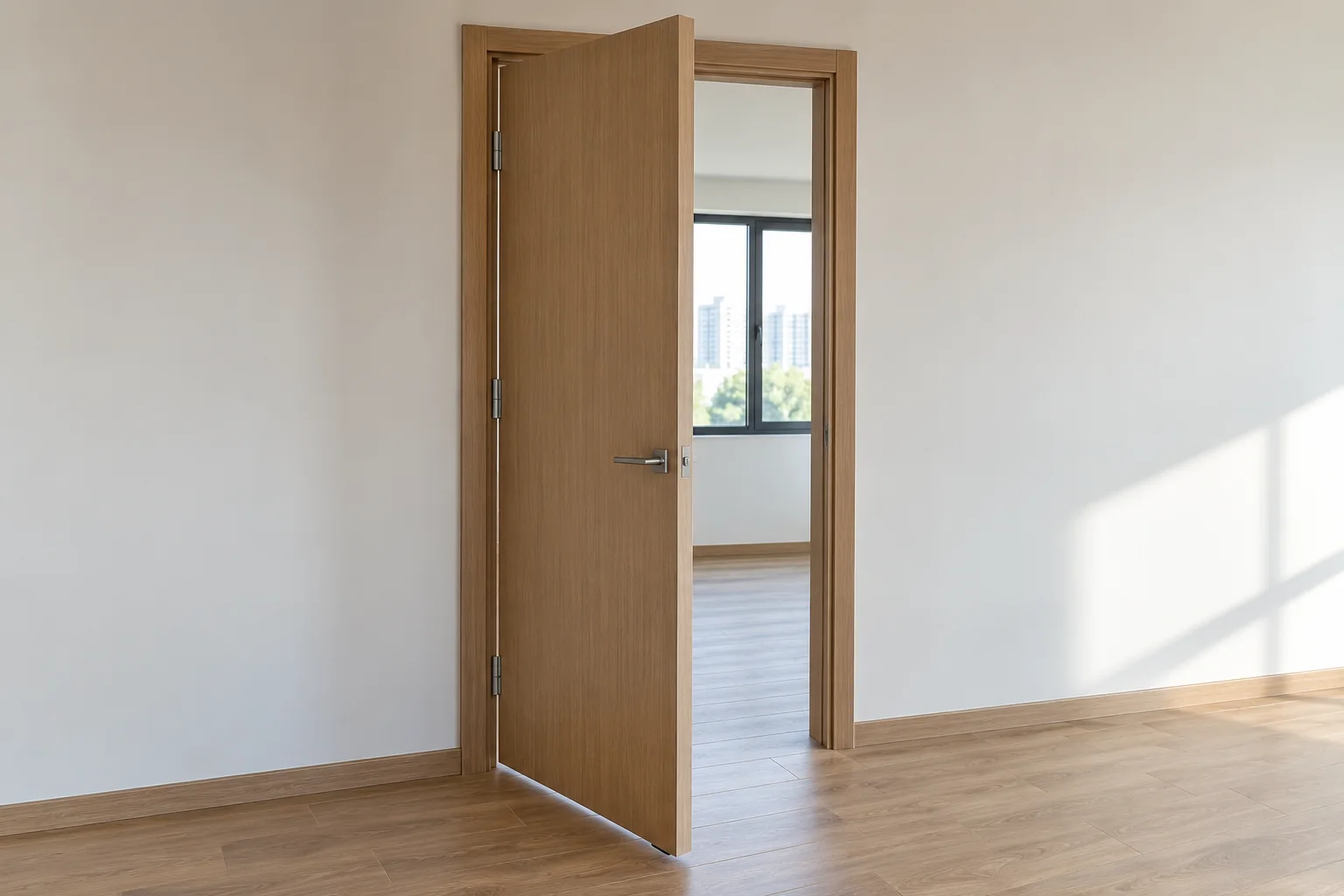
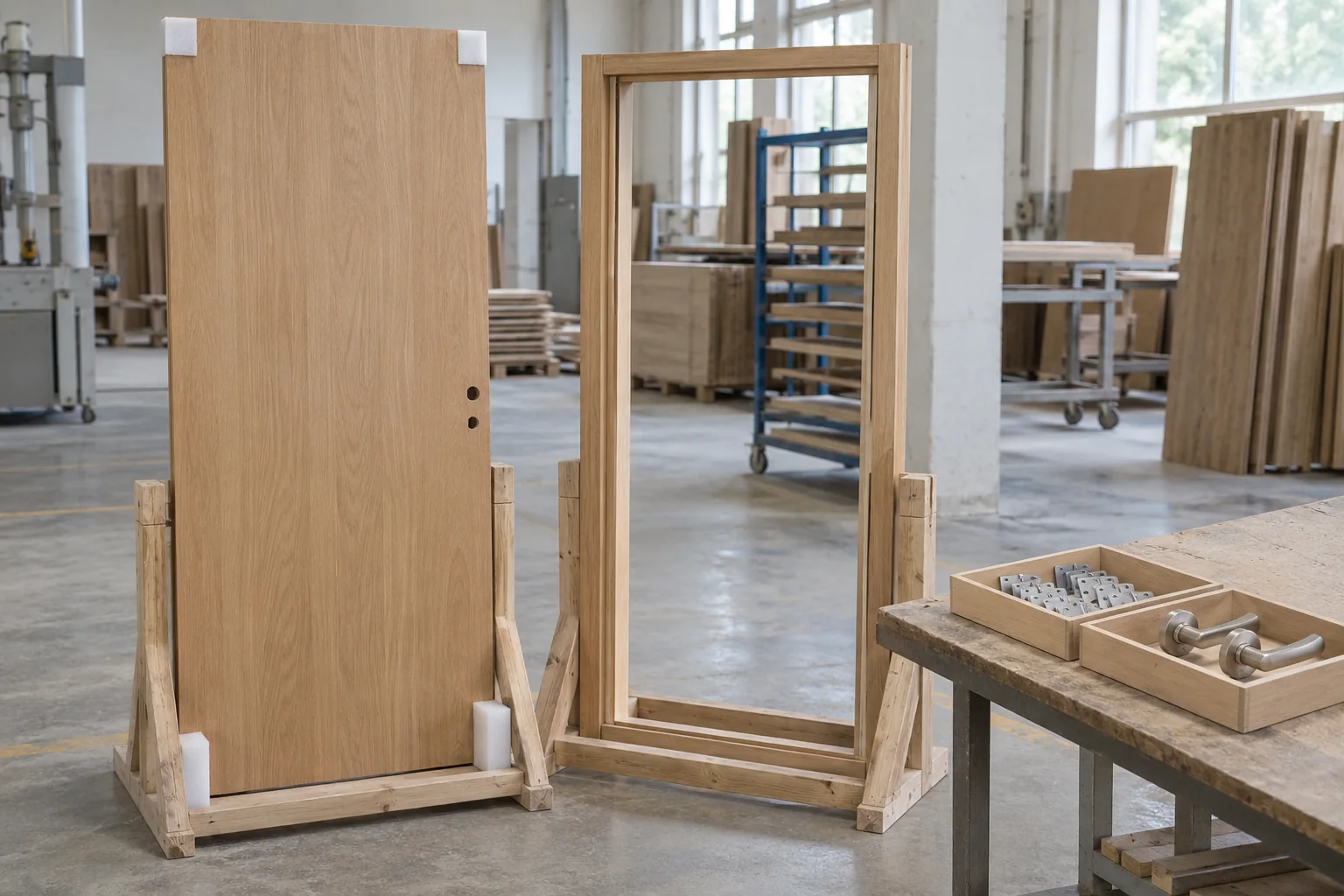
AI-generated illustration of a door movement relationship; no approved handing, clearance or hinge duty is represented.
Which direction must the swing doors open?
Record the reference view and intended movement
Assign the door to an opening ID and identify the rooms or sides it connects. Show the direction of movement on the relevant plan. A handing abbreviation should accompany that representation rather than replace it. Ask the supplier to explain its convention before translating the buyer’s schedule into manufacturing information.
State the reference side from which hinge and latch positions are described. A drawing viewed from another room can make a seemingly correct label misleading. The reviewer should be able to trace the leaf’s movement without guessing whether the schedule uses an interior, exterior or another defined view.
For paired leaves, identify active and other intended operating leaves, their movement and selected hardware arrangement. A double-door symbol cannot establish the sequence or functions of each leaf. Keep these configurations distinct from a single-leaf opening even when finishes and overall widths appear similar.
Check the active leaf’s usable passage in ordinary mode separately from full pair opening. A diagram showing both leaves open may not represent daily use when another leaf remains secured. Record that operating state in the assigned-function and hardware review before its geometry is accepted.
Keep the door’s assigned function visible
Record its location, normal use and any special role assigned by the responsible project reviewer. A room-access door can require different evidence from an opening with fire, smoke, escape, security or specified user-access functions. Procurement should obtain the applicable requirement and owner rather than choose direction from aesthetics alone.
The wider door and window schedule should carry the same opening and configuration references. A later room or function change can affect direction, hardware and acceptance. Keep those changes connected with the actual door record before treating the earlier handing decision as current.
If an alternative opening mode is proposed, identify why it is being considered. A sliding door option changes movement and installation questions. It should not receive automatic acceptance merely because it avoids one swing conflict in the plan.
What should guide hinge and hardware selection for swing doors?
Identify the actual leaf and frame
For swing doors, obtain leaf dimensions, relevant mass, construction and the proposed frame. Added glazing, facings or hardware can change the assembly being reviewed. A similar-looking leaf from another material or width should not inherit a hinge application without an appropriate supplier response.
Ask where hinge components engage the leaf and frame and what their selected application information requires. The load path includes those connections and the frame’s attachment to its supporting construction. An isolated hinge value cannot approve every connection in that chain.
Use this register to prepare a reviewable door package.
| Input | Required record | Responsible party | Approval boundary |
|---|---|---|---|
| Opening and handing | ID, reference view and movement plan | Designer and coordinator | Abbreviation alone is insufficient |
| Leaf and frame | Construction, dimensions and relevant mass | Door supplier | Appearance does not establish hardware duty |
| Hinge application | Exact model and applicable conditions | Hardware supplier | Published value needs matching configuration |
| Other hardware | Closer, latch, stop and selected functions | Hardware coordinator | Separate parts do not prove a working set |
| Occupied movement | User task and adjacent-object layout | Designer | Closed outline excludes clearance proof |
| Site interface | Floor, reveal and support condition | Contractor and reviewer | Product record excludes unknown building conditions |
The register identifies missing evidence before machining and component orders are fixed. A complete list does not prove suitability. Each record must describe the proposed assembly and allow the responsible reviewer to recognize a changed condition.
Review the complete operating hardware set
Include closers, stops, seals, latches and any selected drive or control arrangement where they form part of the door. Their application can change forces or movement conditions relevant to the hinge and frame. Ask the hardware supplier to review the set rather than approve each component in isolation.
Frequency and place of use belong in that review. A door used occasionally and one repeatedly operated in a public setting can create different duties. Describe the intended routine without inventing a daily cycle count. The actual product information and required verification should address that application.
Keep hardware compatibility and assigned-function evidence separate from color matching. A matching handle finish cannot approve a latch, hinge or closer configuration. Identify who reconciles the complete set and who confirms any requirement that extends beyond ordinary operation.

What can a hinge load value actually establish?
Check its configuration and applicability
Request the exact hinge model and the conditions behind its stated information. Door dimensions, hinge arrangement, installation and other hardware can affect the application. A value expressed against leaf weight should not be interpreted as unconditional approval of a wider or differently operated assembly.
Ask the supplier to identify the represented mounting and construction. Changing leaf material, frame engagement or fastening area can change the chain that the hardware information describes. The responsible reviewer should confirm whether the proposed arrangement is covered and what further evidence is required.
Separate static loading from other specified operating or performance questions. A weight-related record cannot answer every duty, durability or assigned-function requirement. Identify the evidence needed for the actual door package instead of collecting unrelated reports with impressive names.
Make substitutions visible before manufacture
A different hinge can require changed preparation, adjustment or frame information. Ask for the proposed model, reason and affected components. Similar external shape or a matching finish does not establish interchangeability. Review the complete affected application before accepting a substitute.
Keep wooden door construction and aluminium door systems tied to their selected hardware information. Their material names do not establish identical hinge mounting or frame connections. The supplier should describe the actual construction used at those points.
Update machining drawings and acknowledged component orders after approval. A revised hardware schedule should not coexist with earlier leaf preparations in production. Ask the owners to confirm the active revision and retain unresolved details as identifiable holds.
Do swing doors preserve access in the occupied room?
Review the user’s task around the actual opening
Identify how users approach, operate and move through the door. Include relevant furniture, other leaves and fixed objects in the layout. A clear arc on an empty floor plan cannot describe every occupied task. The responsible designer should confirm applicable project and destination conditions rather than accept a generic clearance figure.
Check the usable opening and approach using the selected frame, leaf and hardware configuration. Overall frame width does not establish the space available in the operating position. Project-specific user-access requirements need their own defined evidence and responsible review.
Where two nearby doors operate, test the intended sequence or simultaneous use. Handles and leaves can conflict even when their closed positions fit. Record any accepted operating dependency so installation staff do not resolve a conflict by reversing a door without approval.
Include floors, reveals and adjacent finishes
Check the floor throughout the relevant movement, with final finishes identified. A door can clear its closed position while meeting a rise or projection along its arc. Coordinate selected tile finishes and any transitions with the actual room geometry. A finish category cannot establish a permitted door gap.
Include reveal depth, trim and wall-panel build-up where they affect handles, stops or leaf movement. Their thickness can alter a previous review. The contractor should confirm the finished condition used by the door drawing before components are prepared or adjusted on site.
Ask the hardware and installation reviewers to resolve any stopping or limiting arrangement. It should match the selected application and adjoining construction. A decorative object placed behind the leaf should not become an improvised stop or evidence that the intended movement is controlled.

What should a functional mock-up prove?
Represent the unresolved relationship
Use the proposed leaf, frame and relevant hardware where operation remains uncertain. Record differences in a development sample, such as another closer or missing seal. Those differences can make the sample useful for exploration while leaving final application approval incomplete.
A dimensional stand-in can help review an arc or occupied space without representing the actual leaf mass or hinge duty. State that limit before the buyer accepts the result. A light temporary panel opening easily cannot demonstrate the behavior or required evidence of the supplied assembly.
Have the relevant user or buyer representative perform the ordinary task being considered. Record the starting positions, adjacent objects and product identity. Required formal testing or assigned-function verification remains separate. A successful everyday operation should not be presented as a certificate for every door requirement.
Convert observations into a specific decision
Use this table to determine what evidence or revision closes each gap.
| Observation | Consequence | Buyer decision | Next evidence |
|---|---|---|---|
| Handing labels use different views | Production direction may be wrong | Clarify before ordering | Agreed reference-side movement drawing |
| Offered hinge lacks application match | Duty evidence is incomplete | Hold hardware acceptance | Model/configuration coverage response |
| Added closer changes the reviewed set | Former application may not apply | Reconcile hardware | Complete-set supplier review |
| Leaf meets floor or adjacent object | Intended movement is restricted | Revise the relevant interface | Final-condition movement check |
| Trial omits a relevant seal or fitting | Operation result is limited | Recheck represented configuration | Production-equivalent demonstration |
| Reversal affects an assigned opening role | Approval basis may change | Refer to responsible designer | Revised function and configuration record |
Close the actual relationship rather than issuing a broad request for better quality. A corrected handing label cannot resolve missing hinge information. A changed floor detail cannot approve an unreviewed closer. Each outcome needs an owner and the record that permits the affected stage to proceed.
Record any accepted compromise in the opening schedule. The buyer should understand which task or configuration it affects. Keep further requirements held where a represented trial cannot answer them, even when appearance and ordinary movement have been accepted.
How should swing doors retain approved handing and hardware?
Keep leaf, frame and hardware identities together
Match opening IDs for swing doors across drawings, component schedules, quotes and packing information. Mirrored rooms can use similar finishes with different handing. Installation teams need that identity before assigning a unit to an opening. A visually matching leaf should not be moved between rooms without checking its configuration.
Confirm who supplies frame fixings, site preparation, thresholds, trims and selected accessories. An installation exclusion can be workable when another named party accepts it. Unallocated work leaves the complete operating assembly undefined despite a finished door appearing in the quotation.
For folding-door alternatives or other revised modes, issue a changed configuration rather than editing a handing abbreviation alone. Travel, occupation, hardware and installation can all differ. The coordinator should make those consequences visible to affected suppliers.
Control site changes against the approved records
Ask the contractor to confirm opening, floor and support conditions before installation. If the site differs, identify the affected mounting or movement relationship and request the relevant review. Cutting, reversing or substituting a part should not become an undocumented response to an unexpected condition.
Within whole-house coordination, keep door movement and assigned-function requirements distinct from shared finish approvals. A common decorative scheme does not authorize the same handing or hardware at every opening. Record room-specific exceptions in the active schedule.
Agree how corrections reach the door and hardware suppliers. A new floor thickness or closer choice can affect more than one record. Obtain acknowledgement of the current leaf, frame and component information before treating the change as closed.
What should installed acceptance and handover verify?
Compare ordinary operation with the accepted configuration
Check opening identity, handing, visible components and the documented installation condition. Inspect ordinary movement and user tasks within applicable instructions. Record any difference from the represented trial, including omitted or substituted hardware. Required technical or assigned-function verification retains its own method and responsible party.
Record restricted movement, missing fittings or changed supports by opening ID. Distinguish a supplied-unit mismatch from site variation or installation adjustment. The corrective response should identify whether hardware, geometry or assigned-function acceptance needs reopening before the issue is closed.

Provide a configuration-specific service record
Handover should include accepted leaf, frame and hardware identities, applicable instructions and service references. Identify which adjustments and replacements require the responsible installer or supplier. A general door brochure cannot describe every hinge, closer and seal combination supplied.
Keep actual parts availability and commercial terms explicit. A future replacement should be checked against the accepted assembly rather than selected only by color or visible shape. Where a later change affects movement or an assigned opening function, request the relevant review before treating it as equivalent.
Conclusion
Release swing doors when opening identity, reference-side handing, selected hardware and occupied movement describe one accepted configuration. Obtain hinge information matching the actual leaf, frame and operating set. Keep user-access and any assigned opening-function requirements attached to their responsible reviewers rather than inferring them from ordinary movement.
Before manufacture, ask the coordinator to resolve the least certain handing or hardware relationship. Use represented trials for relevant geometry and operation, with limits recorded where parts or mass differ. Hold missing application evidence, conflicting floor conditions or unreviewed reversals against the affected opening. Preserve accepted changes through acknowledged component records and installed checks.
Sibolla’s procurement service process provides a reference for assembling that package. Send the opening schedule, leaf and frame proposal, selected hardware and open movement questions together so suppliers can respond to a defined release decision.
Frequently Asked Questions
Is a left-hand label enough to order a door?
Confirm the supplier’s convention and reference side, then show the intended movement on an identified opening drawing. Similar abbreviations can describe different views. Obtain an agreed configuration before ordering.
Does a hinge weight value approve the complete door?
It applies within its stated model and conditions. Leaf geometry, other hardware, frame construction and installation still need a matching review. Ask the supplier to identify the covered application and remaining evidence.
Can installers reverse the swing to avoid a conflict?
Refer the proposed reversal to the responsible designer and suppliers. It may change occupied movement, hardware or an assigned opening role. Record the revised configuration and required acceptance before altering the supplied arrangement.
Can a mock-up with another closer approve production?
It demonstrates only its represented operating set. Identify the differences and recheck the selected configuration where they affect the decision. Keep further hardware or assigned-function evidence separate from appearance acceptance.