Ceiling fans with lights need one selected configuration and separate reviews for support, blade movement and electrical control. A preferred housing or light effect can leave the fan mounting and operating arrangement unresolved. The buyer should identify those conditions before a combined fixture becomes an assumed replacement for an ordinary ceiling light.
For an interior contractor or project purchasing team, the decision is whether the offered fan and light package can be released for the actual room. The supplier identifies the complete model, suspension, light assembly and control components. Qualified project personnel review the site support, electrical arrangement and applicable requirements for that selection.
Build the approval around the complete object, its location and the tasks it must support. Keep appearance, represented room observations and required technical evidence distinct. An adjustable drop, remote control or dimmable label does not establish universal compatibility, suitable mounting or every clearance needed by a particular project.
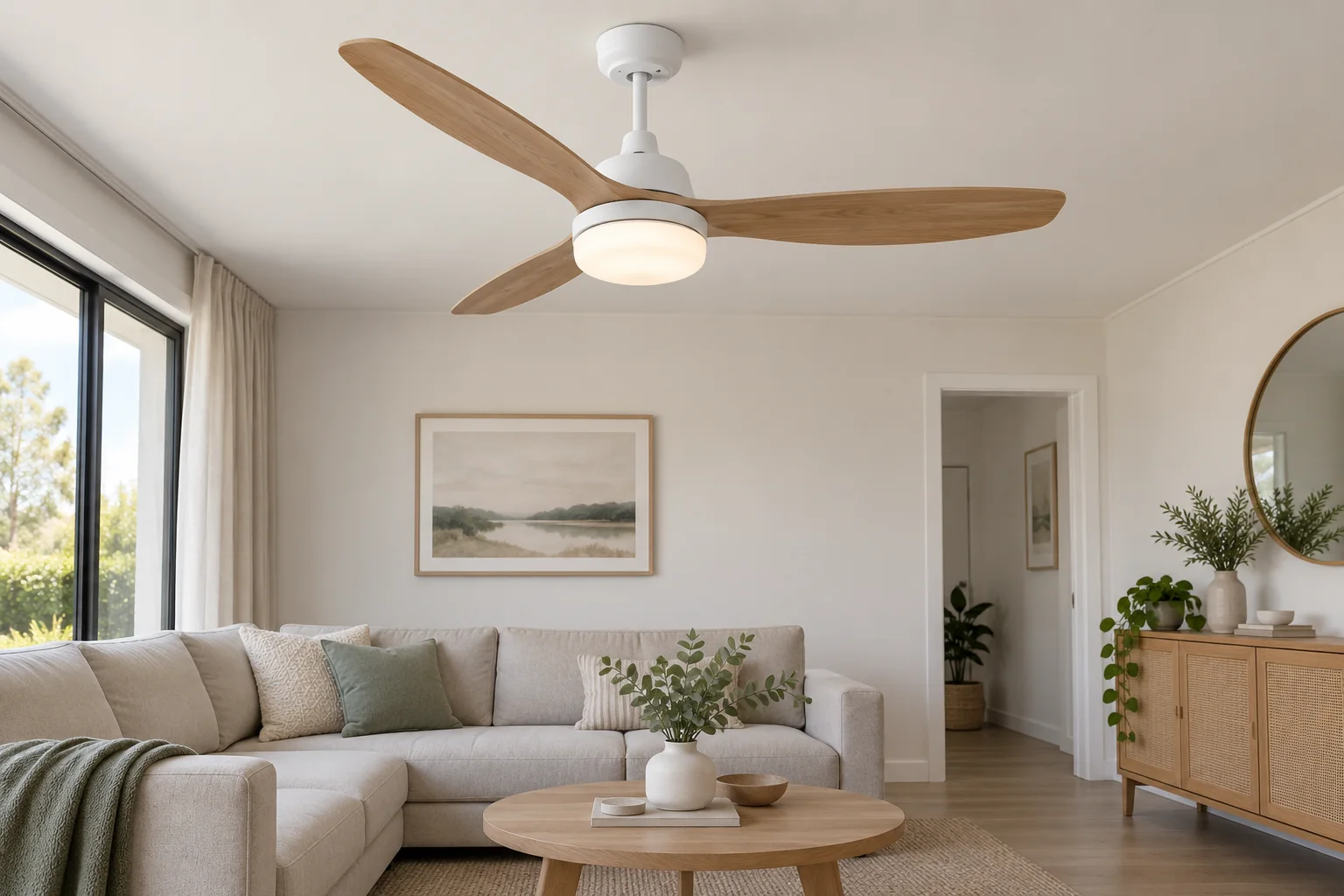
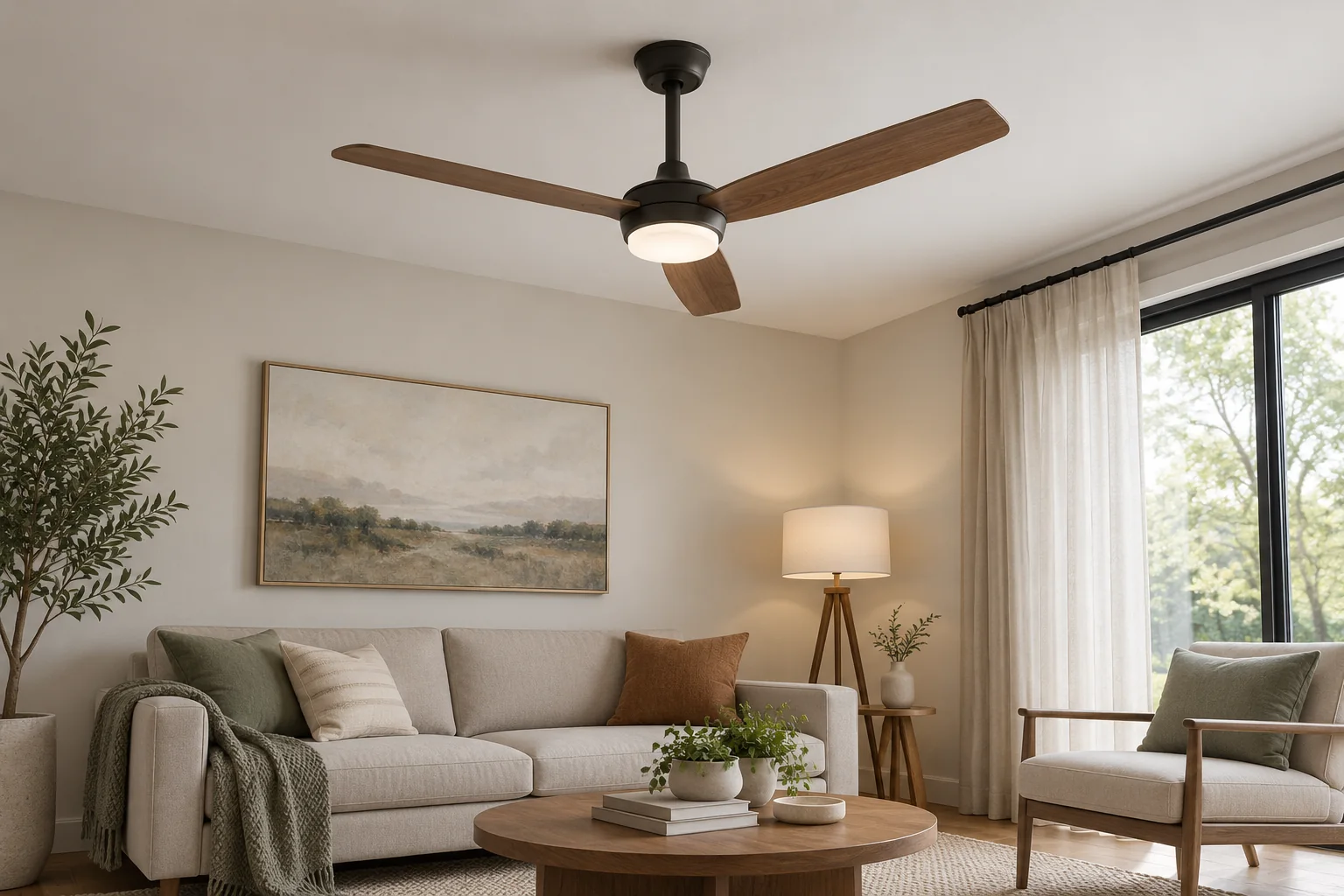
AI-generated illustration of a fan and light configuration; no installed model, airflow result or approved support is represented.
Which ceiling fans with lights are actually offered?
Identify the complete model and selected options
Assign an item reference and record the maker, exact model and selected version. Identify the motor assembly, blade configuration, suspension and light assembly included in the proposal. A catalog family can contain products with different controls, mounting arrangements or application limits.
Use the ceiling fan and light category to begin the enquiry. Attach the intended room and product schedule. The category context cannot establish that a particular combination has been supplied, tested or approved for the buyer’s project.
Ask whether the ceiling fans with lights use integral lighting, a separately selected compatible kit or another stated arrangement. Obtain the relevant light-source and service information for that configuration. A photograph of a fan with a light does not establish that every version of the pictured family includes the same assembly.
Reconcile included and separately supplied parts
List controls, receivers where present, suspension accessories and other required components. Identify what the supplier includes and what another party provides. A proposal can be workable with split responsibilities when the complete configuration and interface owners are explicit.
For the wider lighting package, keep the fan’s motor control separate from ordinary fixture control questions. The light and motor can share a decorative housing while requiring different operating and electrical evidence. Do not compare their quotation scope through a single fixture count.
| Approval input | Required record | Question to close | Confirmation owner |
|---|---|---|---|
| Complete configuration | Model, blade, suspension and light identities | What exactly is offered? | Supplier and buyer |
| Site support | Selected mounting information and actual structure | Which interface needs review? | Supplier and qualified project personnel |
| Movement envelope | Full dimensions and relevant room references | Which obstructions must be coordinated? | Designer and installation reviewer |
| Motor and light controls | Named components and intended operating states | Which combinations are supported? | Makers and qualified electrical reviewer |
| Room use | Tasks, occupants and application conditions | What observations or evidence are relevant? | Buyer and design team |
| Parts and handover | Service identities and actual supply conditions | How will later change preserve approval? | Supplier and operator |
The register makes an incomplete input visible. A selected finish can advance within its agreed scope while a support or control question remains open; the buyer should state the commitment that each confirmation permits.
What mounting evidence do ceiling fans with lights need?
Separate decorative finish from support
Give the responsible reviewer the selected fan’s mounting information and the site’s actual supporting construction. Identify what is known and which concealed condition needs confirmation. A completed ceiling surface or former light position does not establish the support appropriate to a different operating assembly.
The review must address the proposed complete fan and its documented mounting conditions. If a fan-rated support box or direct structural arrangement is required by the selected information, identify the relevant object and site evidence. Procurement should obtain the accepted interface from qualified project personnel rather than choose fixings from appearance.
For ceiling-light alternatives, recognize that replacing a stationary fixture with a fan changes the review object. An existing position can provide useful location information without proving the mounting or control basis for the new assembly.
Match suspension and ceiling geometry
Record the actual ceiling geometry and selected suspension. A sloping ceiling, different mounting position or altered drop may require a different maker-approved arrangement. Obtain the configuration information rather than treating every accessory or downrod as interchangeable.
Identify any component housed within the canopy and the access it requires. A suspension detail should not conceal an unresolved receiver, connection or service-space question. Coordinate those objects through their actual maker documents and appointed electrical and installation reviewers.
If a site or suspension input changes, ask which earlier confirmation still applies. The response may concern a mounting component, available space or the complete assembly. Retain the revised drawing and reviewer outcome before the changed package is released or installed.
How should ceiling fans with lights fit the room and its obstructions?
Review the whole operating envelope
Obtain the complete assembled dimensions and relevant movement information. Record the blade perimeter and lowest relevant element against actual finished room references. A body diameter or suspension length alone may not describe the full object that the installer needs to coordinate.
Include beams, other fixtures, opening movements and access routes that affect the selected location. For a nearby chandelier, retain its full suspension and envelope as a separate object. An overhead composition should not be approved by checking each fixture against an empty ceiling drawing.
For doors and windows, identify relevant moving elements that approach the fan’s area. Give the designer their actual configuration and operating information. A fixed opening outline cannot represent a projecting sash or another movement that changes the room relationship.
Preserve the conditions used by the review
Coordinate curtain rails and treatments with their intended position and movement. A revised rail or treatment can alter the previously represented arrangement. State the affected room and ask which location or application confirmation must be reconsidered.
Include final ceiling and floor levels where they control the accepted geometry. Incomplete finishes can support a provisional enquiry while leaving production or installation inputs unresolved. Identify who confirms the actual reference and how that confirmation reaches the supplier and site team.
The appropriate project reviewers determine applicable clearances and use restrictions for the selected model and destination. This article gives no universal blade-to-wall or floor distance. A perspective image can help locate a relationship without replacing the actual dimensions and responsible review.
Which controls need confirmation for ceiling fans with lights?
Define the operating states before choosing controls
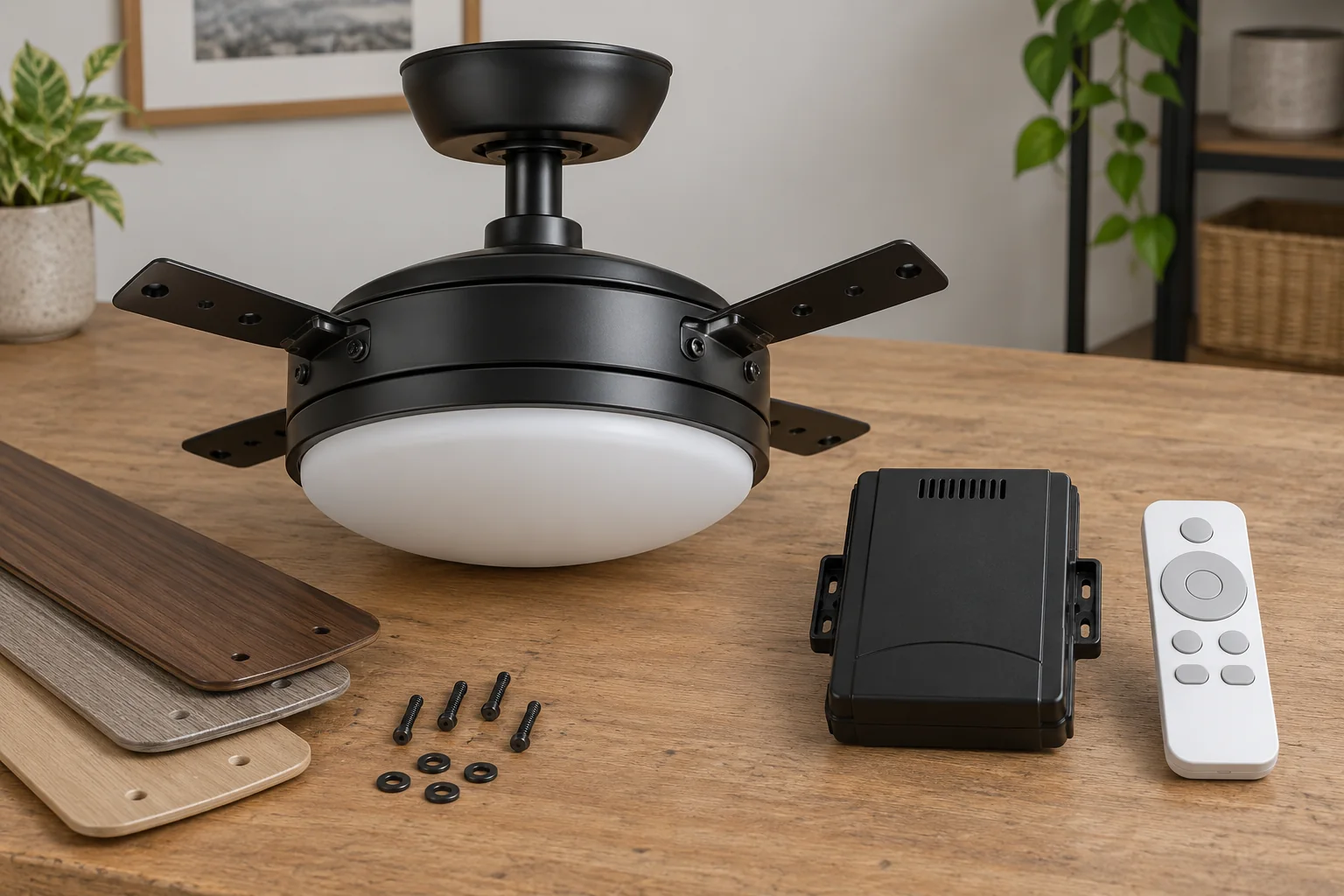
State what users must operate: motor on/off, intended speed settings, direction where applicable, light switching and any requested light adjustment. Identify how these tasks are accessed from the room. A single remote image cannot explain the actual functions or control arrangement included in the order.
For commercial lighting coordination, clarify whether the selected fan belongs to a shared operating scheme or uses independent controls. The system reviewer needs the actual proposed arrangement, including components supplied by another party. A design intention to control everything together is insufficient compatibility evidence.
Ask whether the proposed wall control or existing switching arrangement is suitable for that fan and light selection. Motor speed control and light dimming are different functions. Do not apply a general lighting dimmer to an unspecified fan assembly through a shared dimmable description.
Define which room or zone each control is intended to operate when several units are supplied. Keep the assigned fan and light identities with that control reference. Ask the system reviewer how the accepted pairing is preserved through allocation, setup and later replacement. A common remote appearance does not establish the intended operating assignment for every room.
Retain the pairing and its limitations
For ceiling fans with lights, obtain the actual fan, receiver, control and light-source identities through applicable maker information. Confirm which operating states their reviewed combination supports. A control described as universal can still have a stated product scope; the buyer needs that boundary rather than a promise covering every motor or light kit.
Identify behavior required after loss and restoration of supply or after another ordinary control action where it matters to operation. Ask which states have been reviewed and which need confirmation. Keep observations attached to the actual combination so a substituted receiver or control does not inherit another model’s result.
Electrical supply, wiring, protection and installation must be established by qualified personnel using applicable product and project requirements. Procurement’s useful output is the agreed component and responsibility record. This guide provides no wire colors, connection sequence or field modifications to bypass an unresolved control condition.
What should the room trial actually demonstrate?
Separate fan and light tasks
Describe the room tasks the design wants to observe, such as normal control reach, preferred light scene or the represented effect at occupied positions. Choose the selected configuration and conditions relevant to that question. An operating sample in another room can leave important site and use differences unrepresented.
For a bedroom furniture arrangement, retain the actual bed and headboard location where they affect controls, viewing or access. A decision made from an empty room plan can change when furniture is installed. The trial should identify the relevant setup rather than assume a generic room name defines it.
For a sofa group, record the occupied positions included in the observation. A preferred response at one place does not demonstrate every other position. Define what the review accepts and any operating or design question still needing evidence.
Avoid converting a brief observation into performance proof
A represented room observation can help resolve use or design uncertainty without establishing airflow output, acoustic performance, energy savings or complete technical conformity. If the project requires quantitative evidence, identify the applicable method, complete configuration and responsible reviewer separately.
For complementary wall lamps, review the intended lighting relationship and control ownership without assuming the fan’s light covers every task. Record the actual fixtures and settings used for comparison. An attractive photographed scene does not supply measured illumination or glare evidence.
When an observation differs from expectations, retain the actual configuration and conditions before proposing a remedy. Ask the relevant maker and project reviewer which cause and next action are supported. A noise or movement concern should not become an improvised adjustment procedure or automatic defect diagnosis from a short video.
How should packing, parts and service preserve identity?
Reconcile the components needed for installation
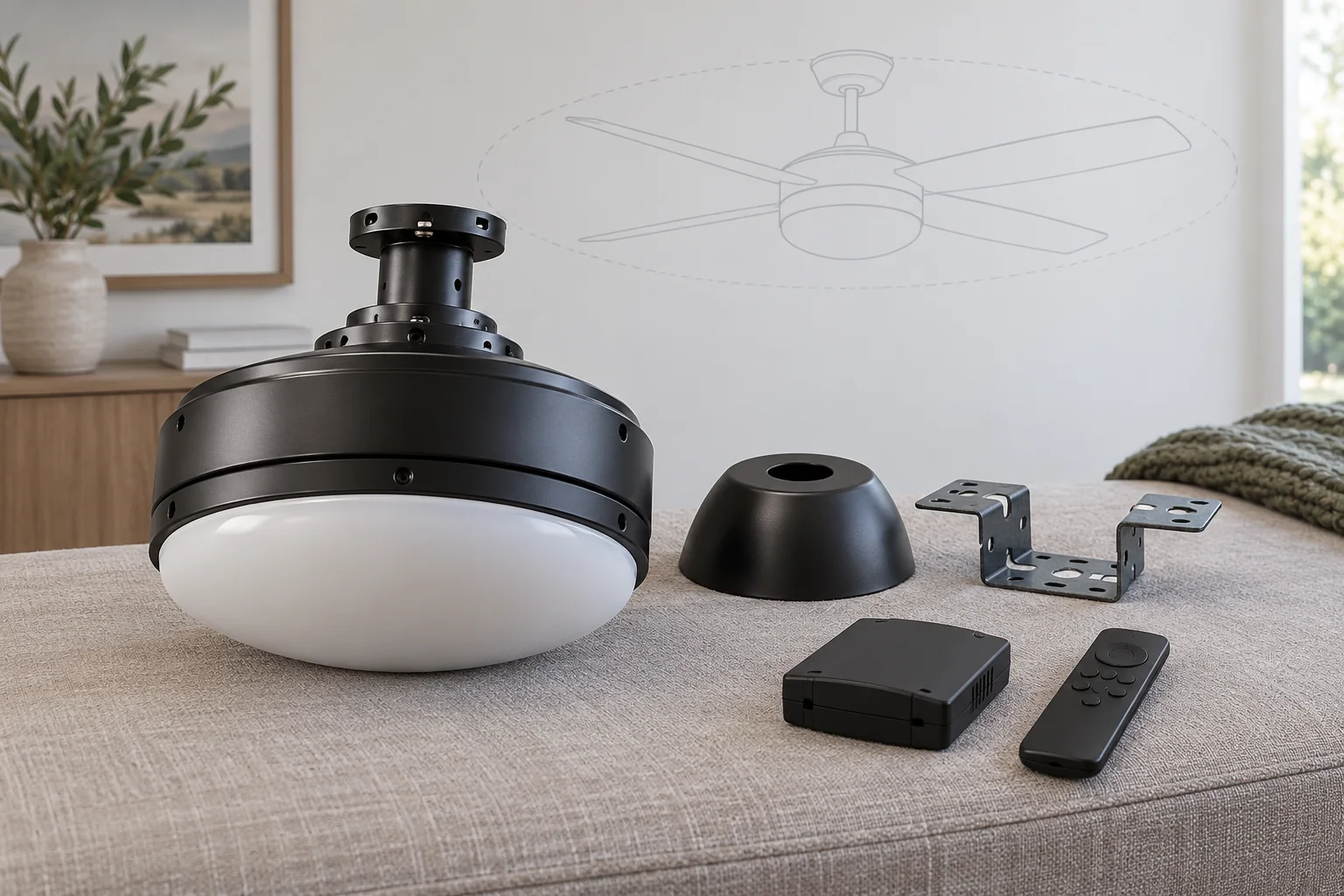
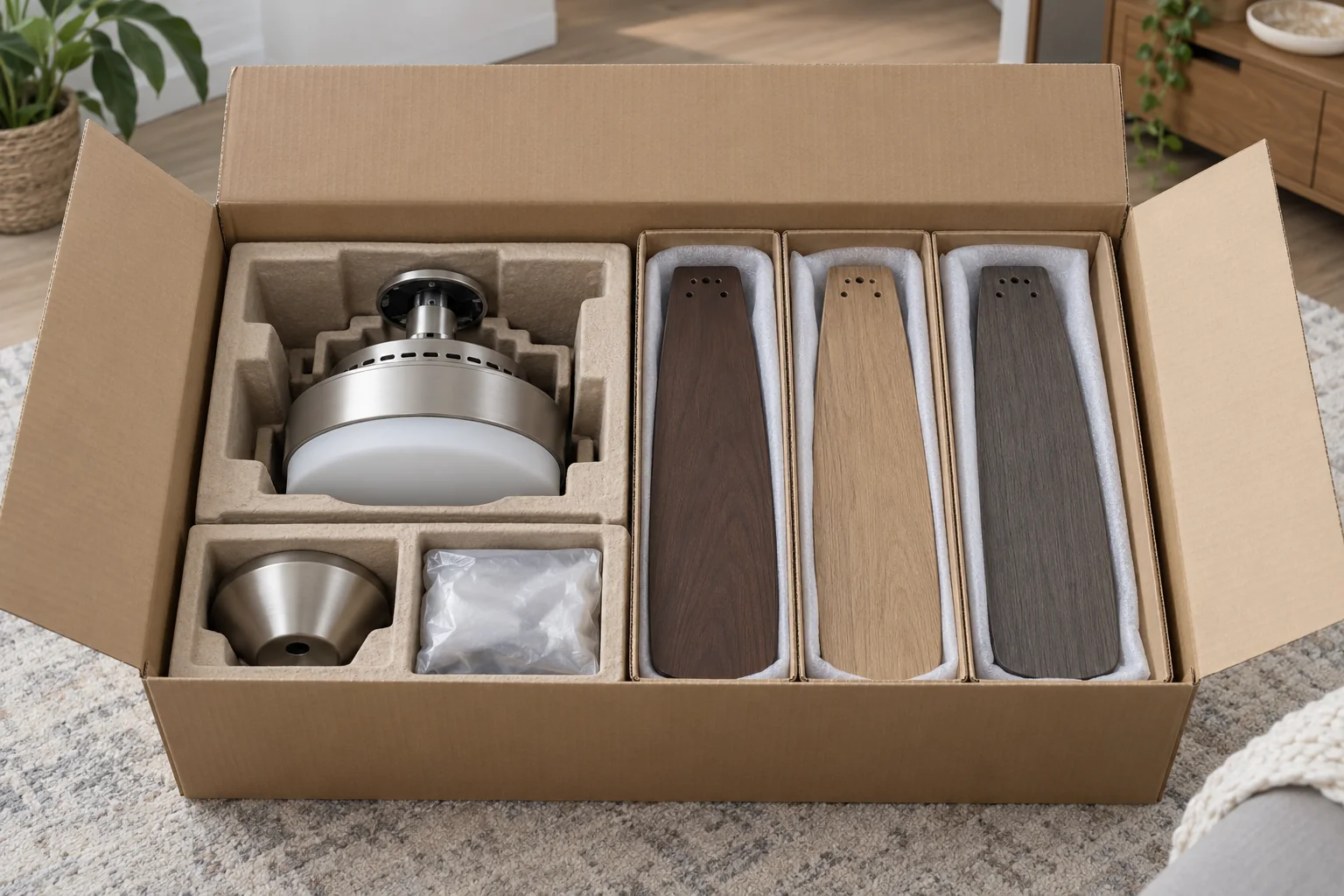
Obtain the actual packed arrangement and part identities. Separate the motor/light assembly, blades, suspension and controls where the supplier packs them independently. Receiving staff should be able to locate which pieces belong to each accepted configuration before multiple packages are distributed to rooms.
Ask how blade and finish references are kept identifiable when several variants are supplied. Matching attachment appearance does not approve another set or assembly. A missing or different part should return to the supplier and relevant reviewer rather than be substituted from another carton by visual similarity.
Use the supply coordination context to agree receiving, protection, storage and delivery responsibilities. State the actual order conditions. A general logistics description does not prove that this fan’s parts, accessory scope or handling method has been reviewed.
Identify the object that requires later attention
Ask what can be serviced or replaced and which work requires appointed personnel. A lamp, integral source, receiver, blade or suspension part can have a different procedure and compatibility question. Obtain actual instructions and replacement conditions for the installed model rather than infer permanent availability.
For whole-house coordination, retain the fan’s configuration and service route with the room reference. Later ceiling, lighting or furniture changes should remain visible where they affect access or approved use. Shared finish selection does not establish the same service conditions throughout the project.
Keep model and component references accessible after packaging is discarded. The operator needs an answerable replacement request that identifies the actual assembly and affected part. If a substitute changes support, control or operating conditions, seek the relevant reconsideration before accepting it through the original approval.
When can the fan and light package be released?
Give each finding a specific next action
Read the model, support, room envelope, control pairing and required application evidence together. A complete-looking fixture can still lack the site or system information needed for its next commitment. Name the affected item and who obtains the missing confirmation.
| Observed condition | Decision affected | Buyer response | Closure evidence |
|---|---|---|---|
| Light or controls differ across records | Offered configuration is uncertain | Reconcile the selected model and included parts | Matching schedule and document identities |
| Former light support is assumed sufficient | Fan mounting is unreviewed | Obtain actual selected-fan/site review | Accepted support interface |
| Room plan omits a nearby moving object | Envelope approval has incomplete conditions | Coordinate the actual movement | Current geometry and applicable clearance review |
| Motor control is described only as dimmable | Pairing and functions remain open | Request model-specific control information | Identified combination and operating scope |
| Trial uses another room or configuration | Observation has a limited basis | Define the difference and recheck as needed | Relevant setup and bounded result |
| Required identities and reviews agree | Scoped release can be considered | Authorize the scheduled package | Retained references and change route |
These are procurement responses. The actual project and agreement determine authorization and any limited early commitment; the table does not supply universal technical limits or legal remedies.
Preserve the release through installed checks
Retain accepted drawings, selected components, relevant maker documents and review outcomes with the room schedule. Ask the appointed installer to identify any site departure before it changes the assembly. A later support or control modification needs an explicit review route rather than an undocumented adjustment.
Obtain required installation and commissioning records from their responsible personnel. A fixture visibly attached to the ceiling does not establish every support, electrical or operating condition. Handover should identify completed reviews, applicable instructions and any remaining scoped confirmation.
Conclusion
Release ceiling fans with lights against the complete selected model and actual room conditions. Give the qualified reviewers the support, suspension, blade envelope and site inputs needed for their decisions. A previous light position or decorative canopy cannot establish the mounting basis for an operating fan.
Identify motor and light functions separately, then obtain the applicable control pairing and electrical review. Use represented observations to resolve specific use or design questions while keeping quantitative performance and technical acceptance separate. Preserve configuration identities through packing, installation and later replacement.
Prepare the fan and light selection, room references, available ceiling-support information and open control or access questions when requesting lighting package sourcing support. Ask what the supplier includes, which documents govern the assembly and what project confirmations remain. That gives the next release a clear, retrievable boundary.
Frequently Asked Questions
Can a former ceiling-light location approve the fan support?
Obtain the actual supporting construction and selected fan’s mounting information for qualified review. The existing location supplies context without proving the new assembly’s support. Keep the affected installation decision open until the applicable interface is confirmed.
Does a dimmable light mean the fan motor uses the same control?
Identify motor and light functions independently and obtain the selected combination’s actual control information. A shared label or housing does not establish the same electrical or operating conditions. The qualified reviewer should reconcile the proposed arrangement.
What does a brief room trial establish?
It addresses its represented configuration, location and stated observation. It cannot automatically prove airflow, noise, energy or every technical requirement. Record its conditions and obtain separate applicable evidence where a quantitative or formal result is required.
Can replacement blades be chosen by finish and hole appearance?
Retrieve the selected fan and component identities and ask the supplier to confirm the proposed part’s application. Appearance alone does not establish a matching set or approved assembly. Reconsider affected support or operation conditions before substitution.