Approve wood doors through their actual leaf construction, exposure and service conditions rather than a species name or surface color. A timber-facing sample can establish appearance while leaving the core, edge treatment, hardware preparation and permitted location undefined. The buyer needs those identities and the relevant product information before accepting the door for manufacture and installation.
For a residential or hospitality package, describe each opening’s environment, operation and care routine. Identify whether it connects similar interior conditions or separates spaces with different moisture exposure. Ask the supplier to explain the proposed complete door, with technical and destination requirements retained by their responsible reviewers.
Sibolla’s wood door range provides the product context. This guide concerns construction selection for actual humidity and service use. It prescribes no universal moisture percentage, acclimation period, trimming allowance or service-life promise for an unspecified product.
AI-generated illustration of wood-door selection objects; no supplied construction, species or exposure approval is identified.
Which conditions must the wood doors serve?
Describe both sides of each opening
Record the rooms or locations joined by the door and the conditions expected on each face. Interior room use, an external entrance and a utility enclosure can pose different questions. A broad location label should lead to an actual exposure description rather than automatically approve every door with a similar decorative finish.
Include relevant humidity, wet contact, sunlight, temperature and cleaning conditions where they affect the proposal. The buyer and designer should identify what is known and what remains assumed. An air-conditioned room can still have changing conditions or an adjacent wet-use space; the presence of cooling equipment is not a complete exposure record.
For openings near a laundry cabinet area or bathroom cabinetry, describe the actual room and cleaning routine. Those adjacent product categories establish context, not wood-door suitability. The door supplier needs its own application review rather than borrowing acceptance from a cabinet material label.
Add the operating and assigned functions
State how users operate the door, how frequently the task occurs and what hardware is proposed. An occasional residential opening can differ from a repeatedly used service door. Describe the routine without inventing a daily cycle count. The actual supplier information and required evidence should address that application.
Identify any fire, smoke, acoustic, security or specified user-access function assigned by the responsible project reviewer. A dense-looking leaf or solid-core label cannot settle every requirement. Ask what complete configuration and applicable records are required before treating a decorative or ordinary operation approval as technical acceptance.
Carry those conditions in the wider door and window schedule. Similar doors can serve different locations while sharing color or dimensions. Keep opening identity and application visible so production and installation do not allocate an accepted interior configuration to another exposure by appearance alone.
What construction is offered for the wood doors?
Identify faces, core and edges separately
For wood doors, ask for the actual leaf construction, including facings, internal structure, edges and relevant joints. A description such as oak door can refer to different material arrangements. The supplier should explain whether the named material describes a visible face, selected components or another stated construction. Appearance does not identify the whole leaf.
Request the frame and any trims as distinct components. They can use materials or treatments different from the leaf. Include glazing and retention details where present. A matching finish cannot establish the same moisture response, preparation or service requirements at every component within the opening.
Use this register to prepare the construction and exposure review.
| Input | Required record | Responsible party | Approval boundary |
|---|---|---|---|
| Opening environment | Both-face exposure and use description | Buyer and designer | Room name excludes complete conditions |
| Leaf construction | Faces, core, edges and connections | Door supplier | Species label excludes whole-leaf identity |
| Frame and hardware | Actual assembly and preparation information | Supplier and hardware reviewer | Color matching excludes compatibility |
| Required functions | Applicable complete-system evidence | Responsible project reviewer | Core description excludes every performance |
| Finish and care | Selected treatment and instructions | Supplier and operator | Sample appearance excludes exposure proof |
| Site readiness | Storage, opening and final-condition records | Contractor and installer | Delivery excludes installation readiness |
Each input should describe the offered configuration and opening. A complete list of material names is insufficient when construction or applicability remains unclear. Keep preliminary assumptions available for pricing while identifying the records needed before dependent components are released.
Reconcile component identity with quotations
Ask suppliers to explain alternatives through their actual construction rather than vague quality grades. A different core, facing thickness or edge arrangement can change the proposal even when the exterior style remains similar. Request the relevant applicability response and update the acknowledged configuration before accepting the substitute.
Confirm supplied and site-completed work, including finish, glazing, frame assembly and hardware preparation. A quotation showing a finished door may exclude some of those tasks. Name their owners and the records governing them before comparing proposals or assuming that a sample represents the complete delivered package.

How should moisture response inform selection?
Review material behavior within the actual assembly
Wood exchanges moisture with its surroundings, and changes in moisture can affect its dimensions and properties. The response depends on material and construction conditions. That mechanism explains why the supplier needs the exposure record; it does not provide a universal acceptance percentage or predict how an unidentified complete door will behave.
Ask which product information addresses the intended conditions on both faces. A finish can affect the exposed surface while leaving joints, cut edges or other components relevant to the review. Do not extend a general moisture-resistant description into a promise that the whole door is waterproof or dimensionally unchanged under every exposure.
Distinguish an interior decorative proposal from a product intended for an external location. The selected construction, protection and care information must cover the actual application. A roof or recessed entrance can alter exposure without establishing the same conditions as an enclosed room. Have the responsible designer describe that relationship explicitly.
Obtain conditions for storage and site readiness
Request the selected door’s storage, handling and finishing instructions before dispatch. Identify the required site conditions and who confirms them. Delivery into an unfinished building does not establish readiness for prolonged storage, finishing or installation, especially where other work can change the surrounding moisture condition.
Ask the supplier how any required conditioning is determined for this product and site. Record its applicable instruction rather than select an arbitrary number of days. The buyer needs an identifiable readiness condition, with uncertainty referred to the responsible parties instead of being closed by elapsed time alone.
Retain relevant records when the actual environment differs from the stated basis. A changed use, incomplete enclosure or wet construction work should reach the supplier and installer before it is treated as covered. Procurement should identify the difference and obtain a response, rather than decide product suitability from one room photograph.
Which finish and preparation details need approval for wood doors?
Define the complete finish scope
Specify the accepted appearance through an identified sample and relevant viewing conditions. Record permitted variation or matching expectations through actual supplier agreement. Natural-looking grain does not establish one species, a defect criterion or a guarantee that every production leaf will reproduce the same pattern.
Ask how faces, edges, joints and prepared areas are treated under the selected construction’s instructions. Factory and site finishing can have different responsibilities. The supplier should identify work remaining after machining or installation and which materials are applicable. A matching color cannot approve an improvised coating or exposed cut treatment.
Coordinate the frame with wall-panel finishes where reveals or trims meet the opening. The finish detail should preserve necessary movement and access without assuming that a flush-looking junction establishes compatibility. Obtain the door and adjoining-finish owners’ acknowledgement of the actual build-up.
Keep machining and hardware within the reviewed construction
Obtain the product’s permitted preparation and alteration information. Hinge, lock or other machining can affect edges and internal parts. The installer should not infer allowable cutting from the thickness of a sample. Request supplier confirmation where the proposed work differs from the acknowledged construction or selected instructions.
For swing-door operation, reconcile leaf and frame construction with the actual hardware. If a wood-faced leaf is proposed in a sliding arrangement, obtain its matching mechanism information. Appearance acceptance does not establish interchangeable mounting or duty across those operating modes.
A folding door configuration adds its own preparation and connection questions. Keep that assembly identifiable rather than apply a single-leaf machining assumption to connected panels. Required assigned-function evidence should also be reviewed before an alteration is accepted as compatible with the supplied door.

What sample evidence should close the selection?
Give each sample an explicit job
Use a finish sample to decide represented appearance, a construction section to explain materials and connections, and an operating assembly for relevant movement. Those objects answer different questions. Ask the supplier to identify which configuration each represents, including differences that leave production or technical acceptance unresolved.
Keep exposure and required performance evidence separate from a short ordinary trial. An opening demonstration can show represented geometry while leaving moisture behavior, durability or an assigned function untested. The buyer should understand that limit before issuing an acceptance message broad enough to authorize unrelated attributes.
Connect findings with a bounded next action
Use this table to identify the evidence needed after review.
| Observation | Unresolved consequence | Buyer decision | Next evidence |
|---|---|---|---|
| Species name describes only the face | Complete construction is unclear | Resolve the material identity | Leaf and edge construction record |
| Proposed use differs from documented exposure | Application coverage is uncertain | Hold location acceptance | Supplier applicability response |
| Finish scope omits an altered edge | Accepted protection may not cover preparation | Clarify the treatment | Applicable finishing instruction |
| Hardware preparation changes the leaf | Former construction reference may not apply | Review the alteration | Identified machining and assembly response |
| Sample differs in core or frame | Trial is not a complete production reference | Record differences and recheck | Selected-configuration evidence |
| Required care task is unworkable | Operator routine remains unresolved | Revise product or operating plan | Accepted material-specific care record |
A correction should address the affected relationship. A clearer core description can resolve identity while leaving exposure applicability open. An accepted finish cannot close an unreviewed hardware cut. Ask the responsible parties to record separate outcomes against the same door configuration and opening.
Update drawings, material references and site instructions after changes. Obtain supplier acknowledgement of the active version before repeated production. A physical sample improvement should become an identifiable specification rather than remain a favorable photograph beside an earlier construction schedule.
How should wood doors retain approved construction and exposure?
Retain materials, openings and site conditions
Identify each leaf and frame of the wood doors against its opening and construction reference. Matching color can conceal another core, handing or treatment. Installation staff should have the accepted allocation before unpacking several similar units. Moving a leaf to another room can change the exposure or preparation that its approval describes.
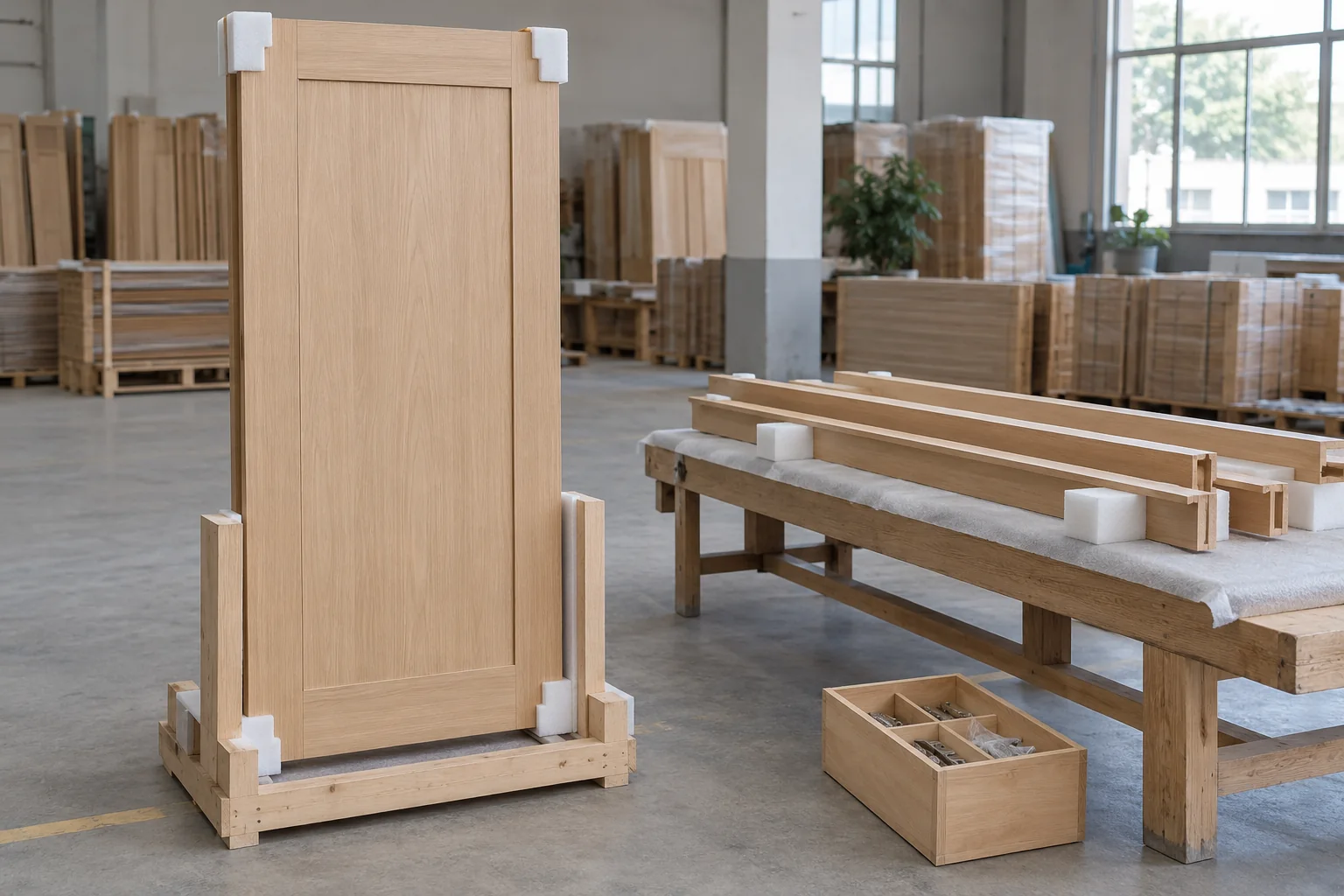
Agree the actual packing and delivery condition with the supplier. Protection should address vulnerable edges, projecting hardware and finishes according to the proposed package. Keep materials and service parts identifiable. A visually intact wrap cannot establish that the door experienced acceptable storage or handling throughout an unrecorded route.
Through Sibolla’s material supply system, preserve named finishing, preparation and installation owners. Confirm site readiness through applicable product information before dependent work. A coordinated supply offer still needs order-specific responsibilities for any remaining treatment or technical acceptance.
Check final geometry before altering the door
Confirm opening, frame and finished floor conditions used by the installation review. A selected tile finish can change the leaf-to-floor relationship from an earlier survey. Record that difference and obtain the appropriate response rather than cut the leaf to a guessed clearance or universal allowance.
An aluminium door alternative should be treated as another proposed assembly with its own evidence and interfaces. Material substitution can affect framing, finish, hardware and care. Do not present a different material as an automatic solution to an unknown moisture or site condition.
For whole-house coordination, keep wood-door exposure and preparation exceptions beside shared appearance decisions. A common grain or color does not authorize identical construction at every opening. Send affected room or service changes back to the supplier before the original acceptance is extended.
What should acceptance and operator care confirm?
Compare supplied construction and actual operation
Inspect identity, accessible finishes, edges and included components against the released references. Review ordinary movement within applicable instructions and record any change from the represented sample. Suspected construction or moisture concerns need their responsible assessment; an attractive face cannot settle the condition of concealed parts.
Keep delivery marks, changed preparation and site observations distinguishable. Link the issue to its opening and next evidence. A proposed cosmetic repair should not automatically resolve an unrelated dimensional or required performance concern. Ask the relevant supplier and reviewer which acceptance needs reopening before closure.
Leave a construction-specific maintenance reference
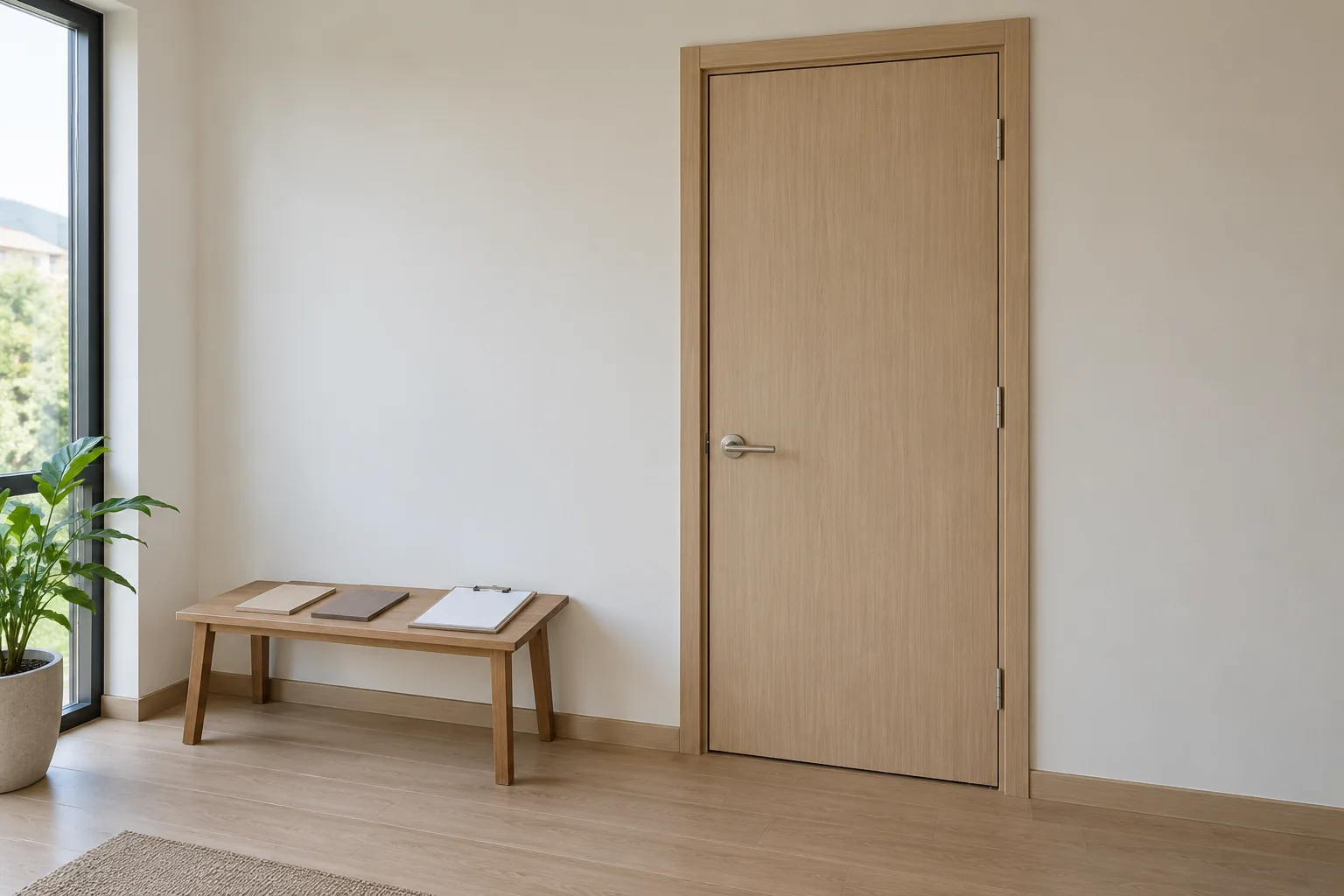
Provide the actual construction identity, accepted changes, applicable care instructions and required verification records. State who performs adjustments, refinishing or component replacement under the supplied information. The operator needs the reviewed assembly rather than a general guide covering different wood products and exposure conditions.
Confirm actual replacement and remedy terms without promising future availability, exact grain matching or universal finish life. A changed cleaning routine, room use or later machining should be reviewed against the accepted conditions. The handover record should make those dependencies recognizable before the former approval is assumed to cover them.
Conclusion
Release wood doors when leaf construction, frame, finish and hardware information match the actual opening exposure and service routine. Identify faces, core and edges separately, and obtain applicable handling, preparation and care records. Keep appearance samples limited to represented attributes while required product and destination evidence remains with its responsible reviewer.
Ask the coordinator to resolve the least certain construction or exposure relationship before manufacture. Hold unclear core identities, omitted edge treatment or unreviewed machining against the affected configuration. Carry accepted changes into supplier acknowledgements and site instructions, then compare final conditions before making alterations. Preserve the reviewed use and care limits at handover.
Sibolla’s procurement service process provides a reference for the next package. Send the opening schedule, exposure description, construction proposal and unresolved finishing or service questions together so suppliers can respond to a specific approval decision.
Frequently Asked Questions
Does a named wood species identify the whole door?
Ask which components it describes. A visible facing, internal structure and edge arrangement can use different materials. Obtain the complete leaf and frame construction reference before treating a species label as evidence for every part or application.
Does a moisture-resistant finish make the door waterproof?
Obtain the selected construction’s exposure coverage and care information. A surface description does not establish every edge, joint or complete-assembly outcome. Keep actual product and site evidence separate from appearance approval or an unqualified finish name.
How long should every wood door acclimate on site?
Request the actual product’s handling and readiness instructions for the intended site. No single period applies to all constructions and conditions. Record the relevant acceptance condition and responsible owner instead of treating elapsed days as sufficient evidence.
Can installers trim a leaf whenever the floor changes?
Refer the proposed alteration to the supplier and responsible reviewer. It can affect edges, internal parts, hardware or an assigned function. Obtain applicable preparation and finishing information, then update the accepted configuration before cutting is authorized.